
Arrows are a great way to show trends and movements in your data set. It also helps make your data easier to comprehend (especially when presenting your data).
While you have the arrow keys on your keyboard, you cannot use them to insert the arrow symbol in a cell in Excel.
But worry not… there are multiple ways you can get the different kinds of arrows in Excel (such as arrow symbols, shapes, and icons).
In this article, I will show you some easy ways to insert arrow symbols, arrow shapes, and arrow icons in Excel.
Follow along with the example file
Insert Arrows in Excel.xlsx
Different Types of Arrows in Excel
Before I show you some ways to insert arrows in Excel, let me quickly explain the different kinds of arrows.
Arrow symbols are like text characters that you can insert in a cell in Excel. These can be inserted using the symbol dialog box, keyboard shortcuts, or formulas.
Below are the most common arrow symbols that you can use in Excel:
| Arrow Name | Arrow Symbol |
|---|---|
| Up Arrow | ↑ |
| Down Arrow | ↓ |
| Right Arrow | → |
| Left Arrow | ← |
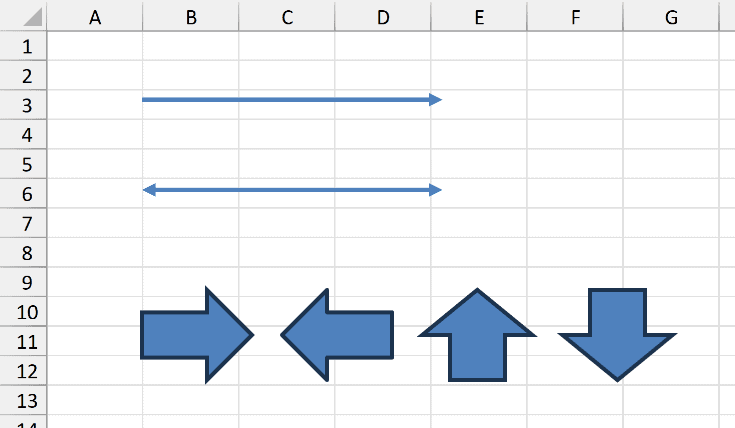
Arrow shapes are what you use if you are working with shapes in Excel and want to use arrows.
This could be useful when working with flow charts or org charts where you want to show the direction of flow with an arrow.
Excel allows you to insert line arrows and block arrows as shapes.
Arrow icons come from Conditional Formatting, where pre-defined rules are used to analyze the value in the cell and then apply an arrow.
For example, say I am looking at the difference between the scores of students in Exam 1 and Exam 2.
I can use a green arrow if the student’s score has increased and a red arrow if the score difference is negative.
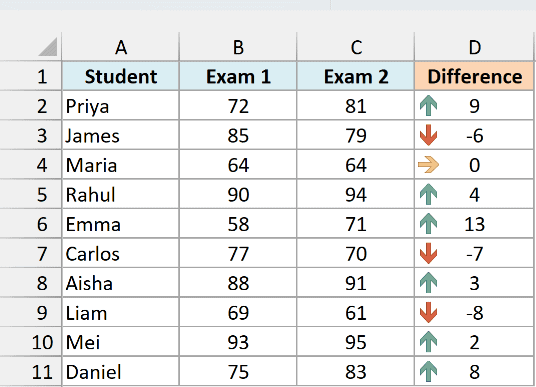
I find these Conditional Formatting arrows quite helpful when creating dashboards or when I want to make my data-heavy reports less boring.
Now that you know about different arrow types in Excel, let’s see how to insert these in Excel.
Let’s look at some ways to insert the arrow symbols in Excel first.
Copy and Paste the Arrow Symbol into Excel
If you want to get the arrow symbol in a cell, the easiest way would be to copy it from somewhere else and paste it into a cell in Excel.
Below, I have provided all the symbol arrows that you can copy and paste into a cell in Excel.
→ ↑ ↓ ← ↔ ↕ ↖ ↗ ↘ ↙ ▲ ▼
Select the arrow you want, press Control + C, then select a cell in Excel and press Control + V.
The pasted arrow is a text character, so you can make it bigger, change its color, or make it bold, just like any other text in a cell.
Keyboard Shortcuts to Insert Arrow Symbols in Excel (Alt Codes)
Below are the keyboard shortcuts you can use to insert the different arrow symbols in Excel:
| Arrow Symbol | ALT Shortcut |
|---|---|
| Up Arrow (↑) | ALT + 24 |
| Down Arrow (↓) | ALT + 25 |
| Right Arrow (→) | ALT + 26 |
| Left Arrow (←) | ALT + 27 |
| Left-Right Arrow (↔) | ALT + 29 |
| Up-Down Arrow (↕) | ALT + 18 |
| Up Triangle (▲) | ALT + 30 |
| Down Triangle (▼) | ALT + 31 |
To use these shortcuts, hold the ALT key and then press the numbers one after the other.
For example, to insert the up arrow, select a cell, hold the ALT key, press 2 and then 4 on the numeric keypad, and then leave the ALT key.
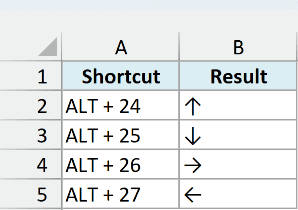
Important: For these shortcuts to work, you need to use the numeric keypad, and Num Lock needs to be enabled.
These ALT keyboard shortcuts would work in Excel as well as other office applications such as MS Word, PowerPoint, and Outlook.
It would also work in Notepad and other applications.
The diagonal arrows (↖ ↗ ↘ ↙) don’t have an ALT code, so for those, use copy-paste, the formula, or the Symbol dialog box covered below.
ALT codes only work in Excel on Windows. On a Mac, press Control + Command + Space to open the Character Viewer, then search for “arrow”.
Insert Arrows Using the Windows Emoji Panel
If your laptop doesn’t have a numeric keypad, the Windows emoji panel is the quickest way to get an arrow without remembering any code.
It works in Windows 10 and Windows 11, and it isn’t an Excel feature, so it works in any app.
Here are the steps to insert an arrow using the emoji panel:
- Double-click the cell where you want the arrow (or select it and press F2).
- Press the Windows key + . (period) to open the emoji panel.
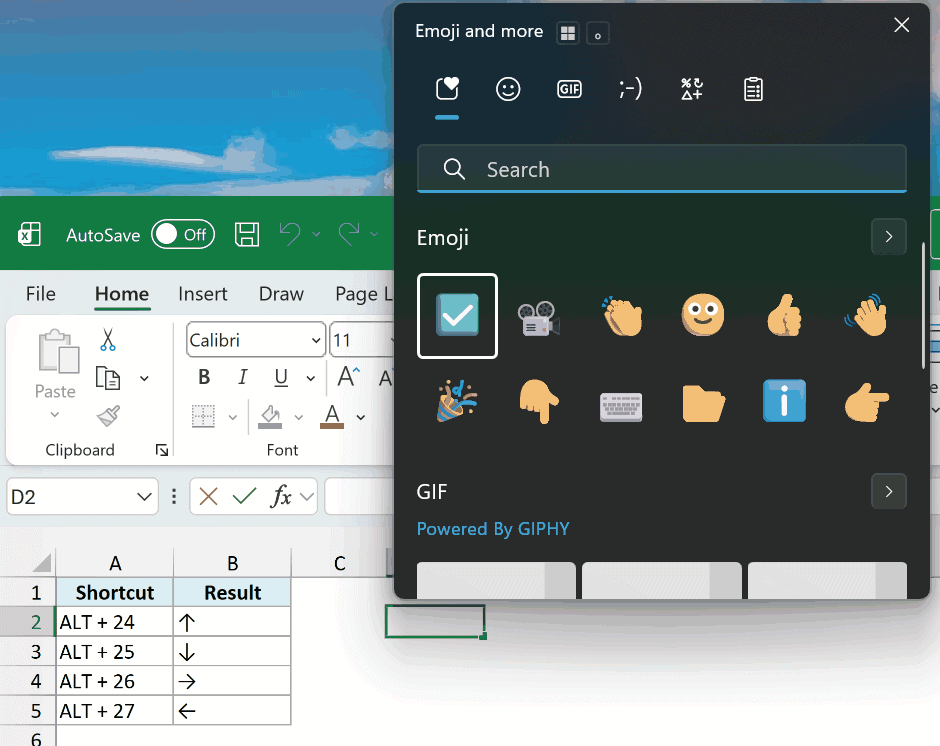
- Click the Symbols icon (Ω), then click Geometric symbols.
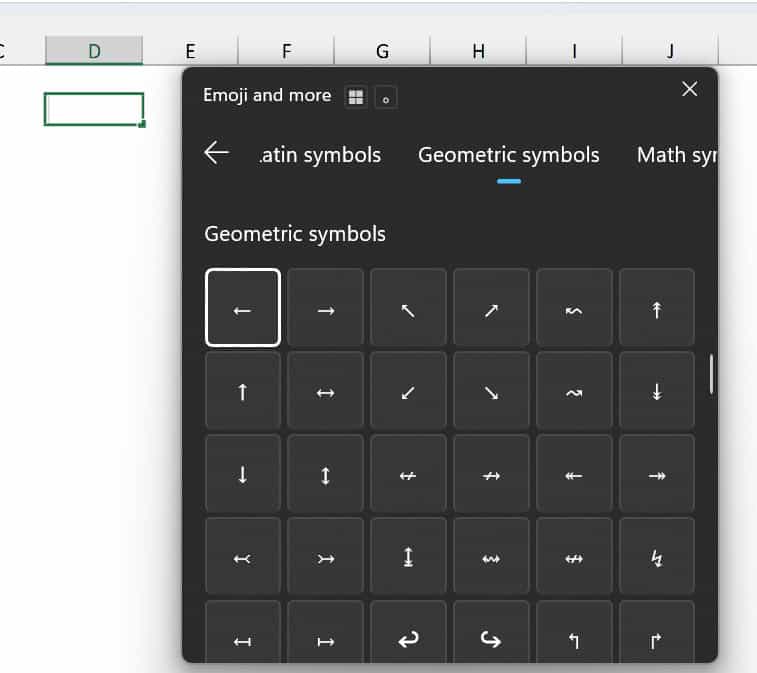
- Click the arrow you want to insert.
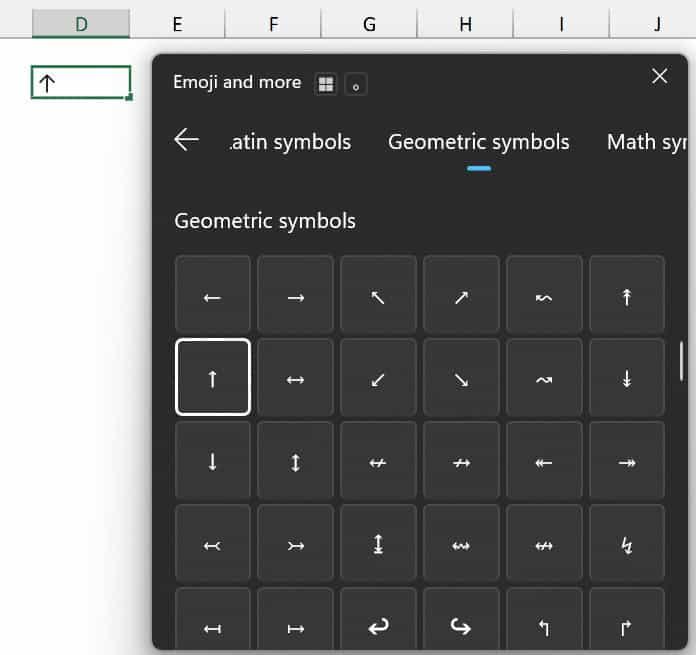
Press Enter to confirm the entry. The arrow goes into the cell as a text character.
Insert an Arrow Symbol Using the Symbol Dialog Box
Below are the steps you can use to insert the Arrow symbol in Excel:
- Select the cell where you want to get the arrow symbol.
- Click on the Insert tab in the ribbon.

- Click the Symbol icon (which is in the Symbols group). If the group is collapsed, click Symbols first. This will open the Symbol dialog box.
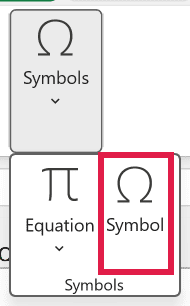
- In the Symbol dialog box, select the Arrows option from the Subset drop-down.
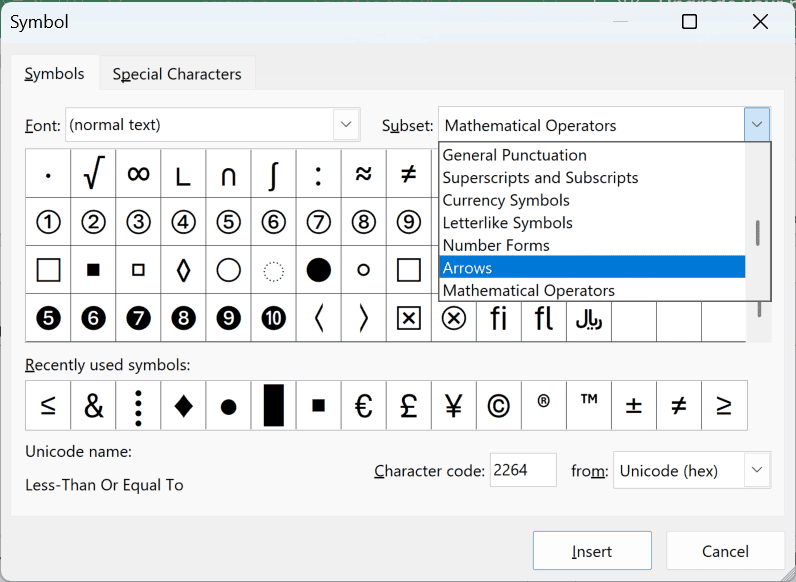
- Select the arrow icon you want to insert.
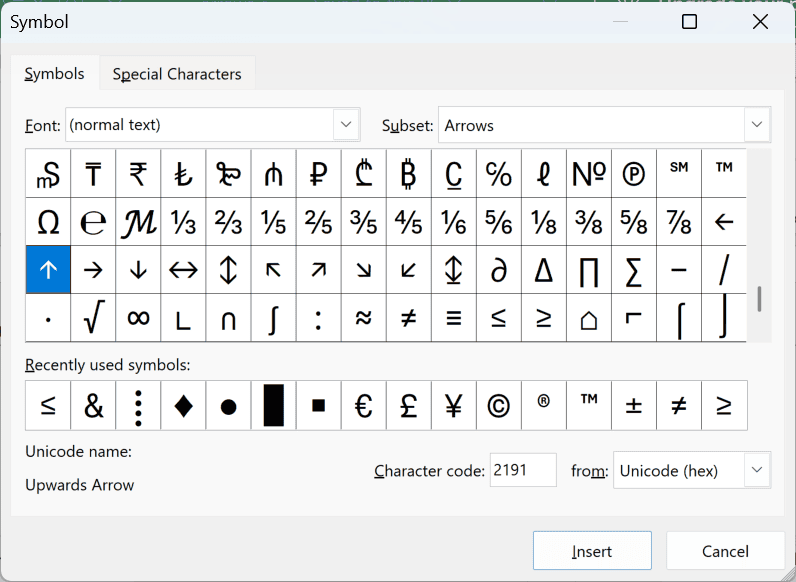
- Click the Insert button.
If you want to insert more than one arrow symbol or different kinds of arrows, you will have to repeat the same process.
So you select the arrow in the symbol dialog box and click the insert button again.
How to Draw an Arrow in Excel (Arrow Shapes)
If you want an arrow that points at something on the sheet (like a chart, a box in a flow chart, or a specific cell), use an arrow shape.
Below are the steps to insert arrow shapes in Excel:
- Click the Insert tab in the ribbon.
- In the Illustrations group, click on the Shapes option (click Illustrations first if the group is collapsed). This will show all the shapes that you can insert in Excel.
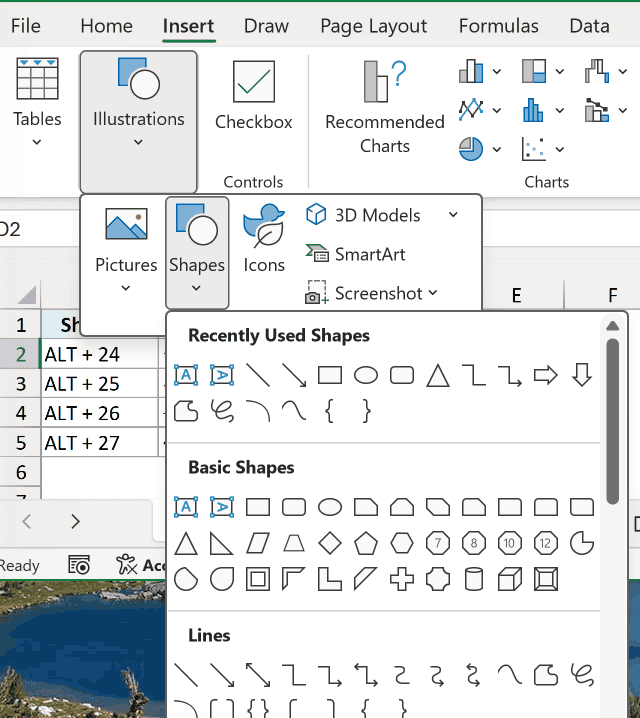
- Click on the arrow you want to insert. This could be the arrows in the Lines category or the arrows in the Arrows category (called Block Arrows in older versions).
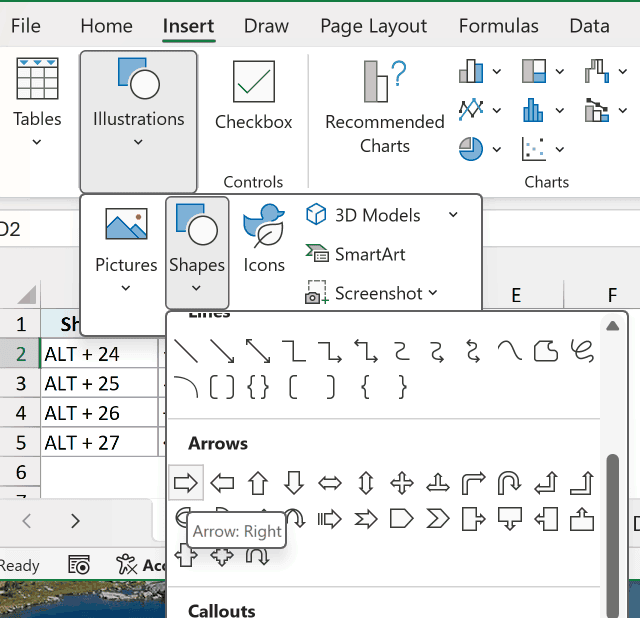
- Click and drag anywhere in the worksheet to draw the arrow (or just click once to insert it at the default size).
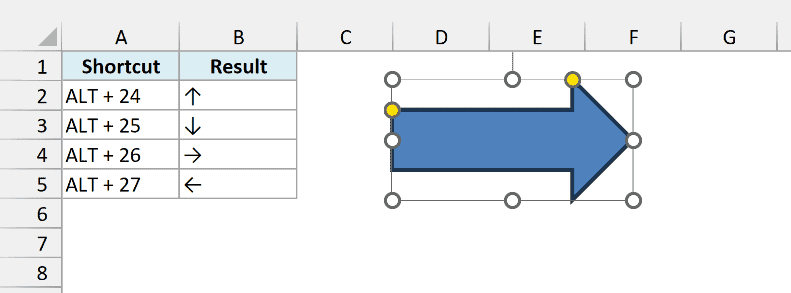
Pro Tip: Hold the Shift key while you drag a line arrow to keep it perfectly straight (horizontal, vertical, or at 45 degrees).
Once you have the arrow shape inserted in the worksheet, you can move it, change its rotation, and format it, such as changing the color or size of it.
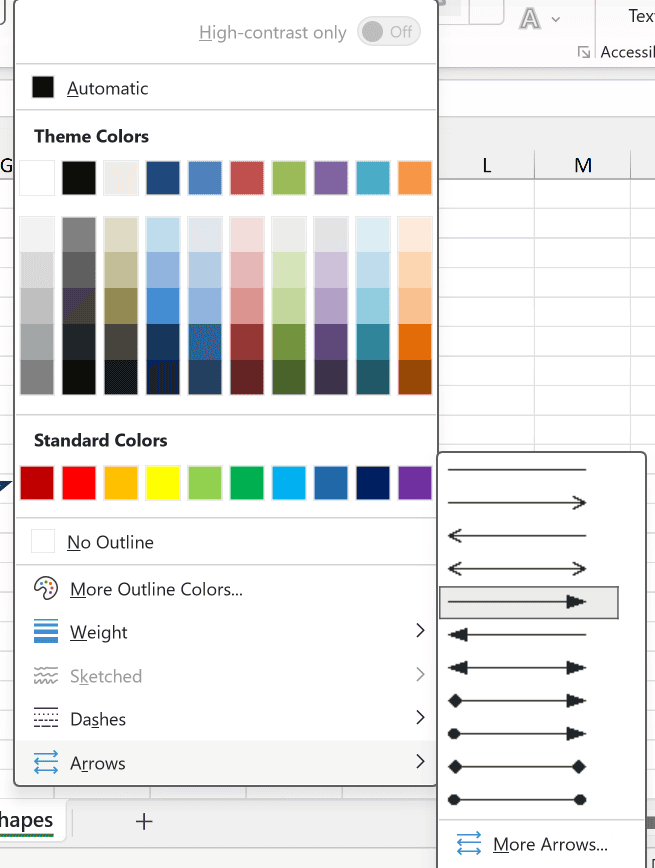
You can also change the arrowhead of a line arrow (for example, to put a head on both ends).
Select the arrow, go to the Shape Format tab, click Shape Outline, and then pick a style from Arrows.
If you use Microsoft 365, you also get arrow icons in Insert > Icons (search for “arrow”).
These are graphics, just like shapes, and you can recolor and resize them. This option isn’t available in Excel for the web.
Also read: How to Insert/Draw a Line in Excel (Straight Line, Arrows, Connectors)
Follow along with the example file
Insert Arrows in Excel.xlsx
Formula to Get the Arrow Symbol (UNICHAR)
Below are some formulas you can use to get the arrow symbol as the result of the formula.
| Arrow | Formula |
|---|---|
| Up Arrow (↑) | =UNICHAR(8593) |
| Down Arrow (↓) | =UNICHAR(8595) |
| Right Arrow (→) | =UNICHAR(8594) |
| Left Arrow (←) | =UNICHAR(8592) |
| Left-Right Arrow (↔) | =UNICHAR(8596) |
| Up-Down Arrow (↕) | =UNICHAR(8597) |
| Up-Left Arrow (↖) | =UNICHAR(8598) |
| Up-Right Arrow (↗) | =UNICHAR(8599) |
| Down-Right Arrow (↘) | =UNICHAR(8600) |
| Down-Left Arrow (↙) | =UNICHAR(8601) |
| Up Triangle (▲) | =UNICHAR(9650) |
| Down Triangle (▼) | =UNICHAR(9660) |
The example file has all these codes in column C, and I want the arrows in column D. Enter this formula in D2 to get all of them at once:
=UNICHAR(C2:C13)
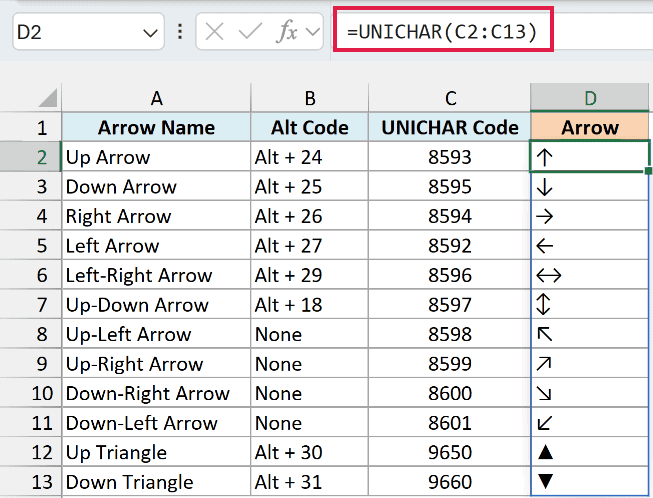
The formula spills down automatically, so you don’t need to copy it. In older versions of Excel, use =UNICHAR(C2) in D2 and copy it down.
You might reach for the CHAR function instead, but it only handles codes up to 255, so =CHAR(8593) returns a #VALUE! error.
To get these arrows, you’ll need the UNICHAR function, which is available in Excel 2013 and later.
Show Up and Down Arrows Based on Cell Values (IF + UNICHAR)
The benefit of using a formula is that you can combine it with other formulas to enhance your analysis.
For example, below, I have the scores of students in two exams.
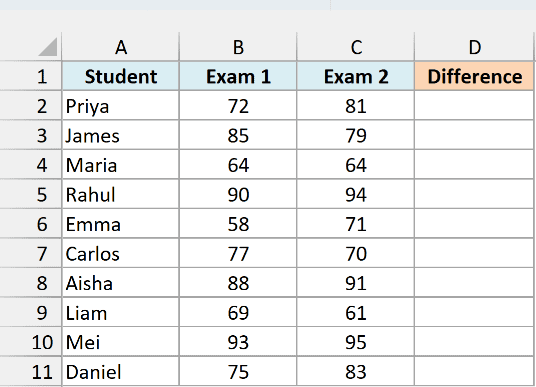
First, I’ll get the difference in the scores in column D. Here is the formula:
=C2:C11-B2:B11
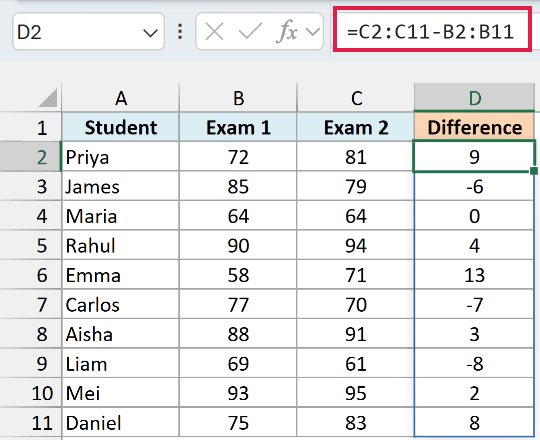
I can make this more visual by adding the IF formula below in column E.
It shows an upward arrow if the score difference is positive and a downward arrow if the score difference is negative.
=IF(D2:D11>0,UNICHAR(8593),IF(D2:D11<0,UNICHAR(8595),UNICHAR(8594)))
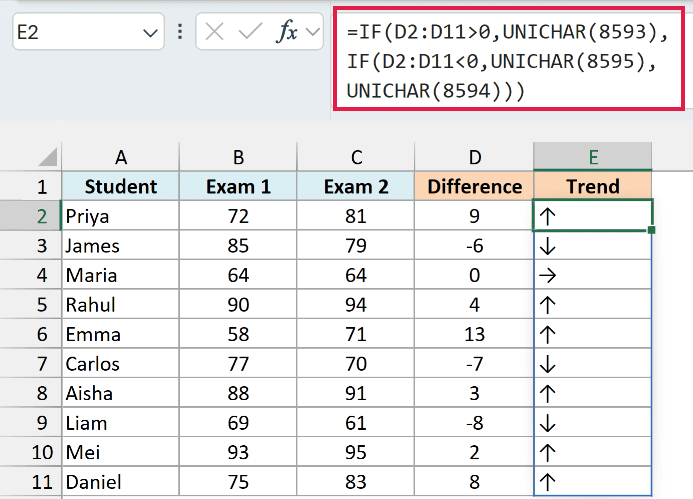
When the score hasn’t changed (Maria scored 64 both times), the formula shows a sideways arrow (→).
Without that second IF, a zero difference would show a down arrow, which isn’t right.
Both formulas spill down automatically.
If you use an older version of Excel, use =C2-B2 in D2 and =IF(D2>0,UNICHAR(8593),IF(D2<0,UNICHAR(8595),UNICHAR(8594))) in E2, and copy them down.
Show Arrows with Numbers Using Custom Number Format
The formula method puts the arrow in a separate column. If you want the arrow and the number in the same cell, you can use a custom number format.
And since this only changes how the cell looks, the value in the cell stays a number that you can still use in calculations.
Below I have the same student scores, with the difference in column D.
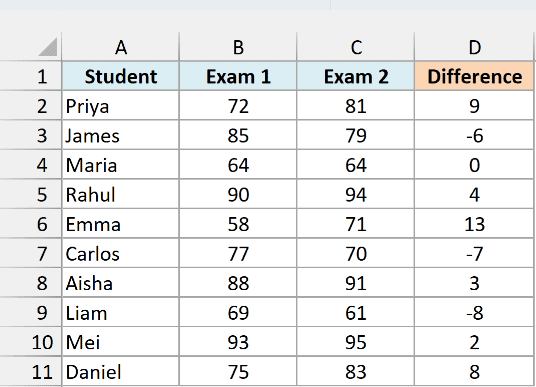
Here are the steps to show green and red arrows with the numbers:
- Select the cells with the differences (D2:D11).
- Press Control + 1 to open the Format Cells dialog box.
- In the Number tab, click Custom, and enter the format below in the Type field.
[Color10]▲ 0;[Red]▼ 0;→ 0
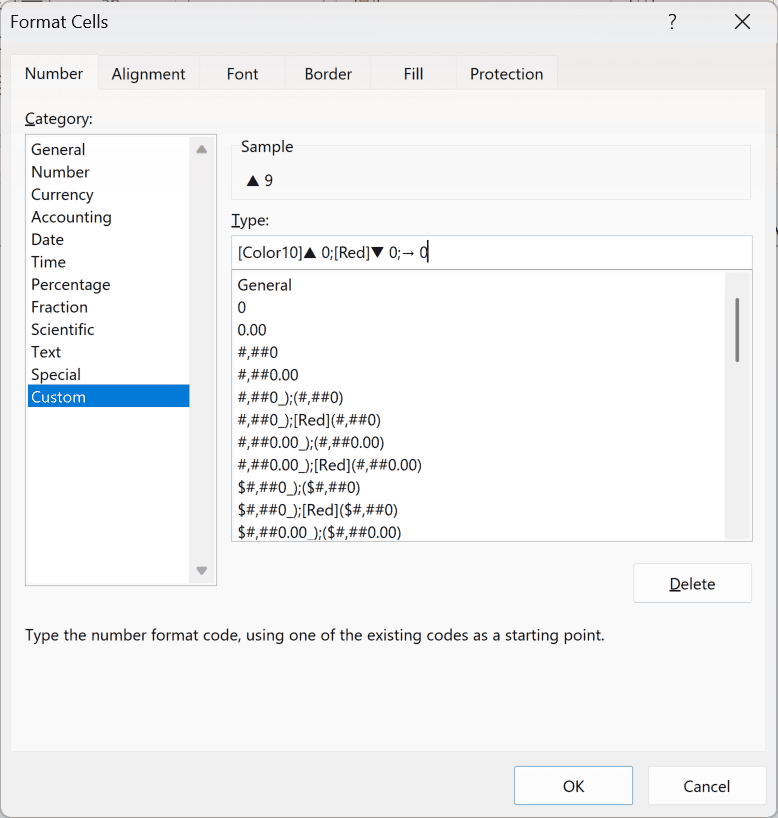
- Click OK.
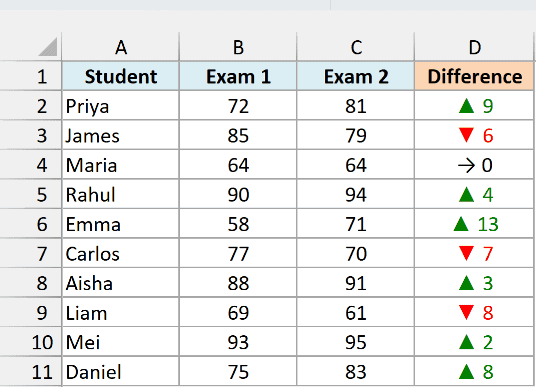
A custom number format has sections separated by semicolons, for positive numbers, negative numbers, and zero. Here is what each one does:
[Color10]▲ 0shows positive numbers in green with an up triangle.[Red]▼ 0shows negative numbers in red with a down triangle.→ 0shows zero with a sideways arrow.
Note that the negative numbers show without the minus sign (James shows ▼ 6). The value in the cell is still -6, which you can see in the formula bar when you select it.
[Color10] is a darker green from Excel’s color palette. You can also use [Green], but it’s a very bright green that’s hard to read.
Copy the arrows from this article and paste them into the Type field.
If you’re new to these formats, here is my guide on Excel custom number formatting.
The same trick also works on chart data labels with arrows.
Insert Arrows Using Conditional Formatting (Icon Sets)
Arrows inserted using Conditional Formatting work a bit differently as they are dependent on the value of the cell.
Let’s say I have the below data set where I have the scores of students in two different exams and the difference in scores in column D.
Now I can use conditional formatting to show arrows that would visibly tell me whether the difference in the scores is positive or negative.
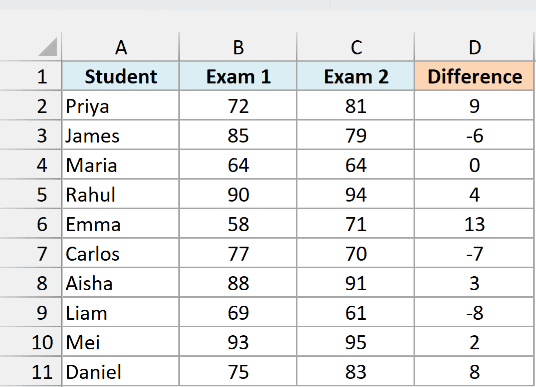
Here are the steps to get the arrows based on the cell value:
- Select the cells based on which you want to insert the arrows (D2:D11).
- Click the Home tab.
- Click on the Conditional Formatting option in the Styles group.
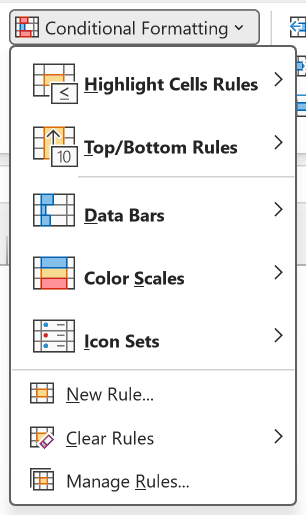
- Hover the cursor over the Icon Sets option. This will show you all the icon sets available for you to use.
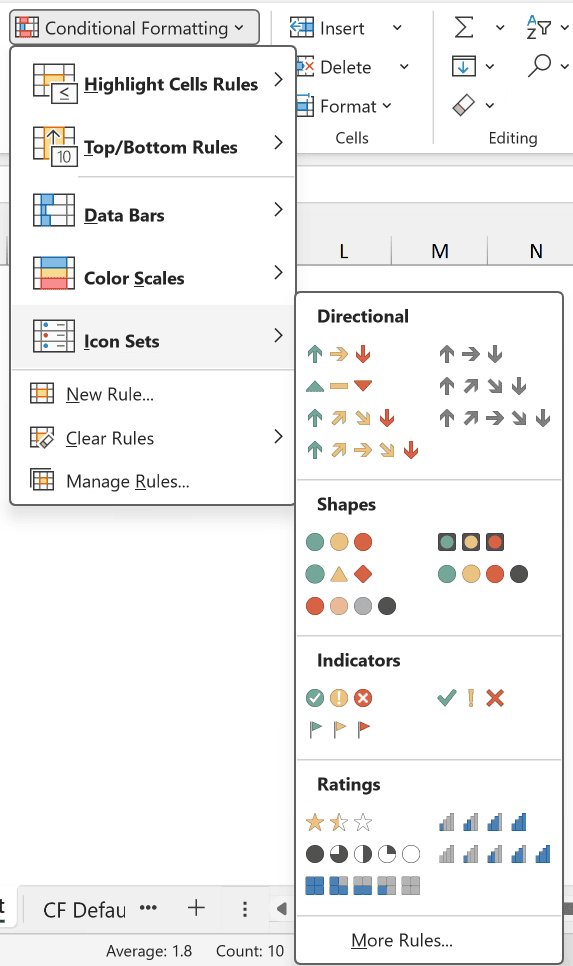
- Select any of the arrow icon sets to apply to your data set. For this example, I will select the 3 Arrows (Colored) option.
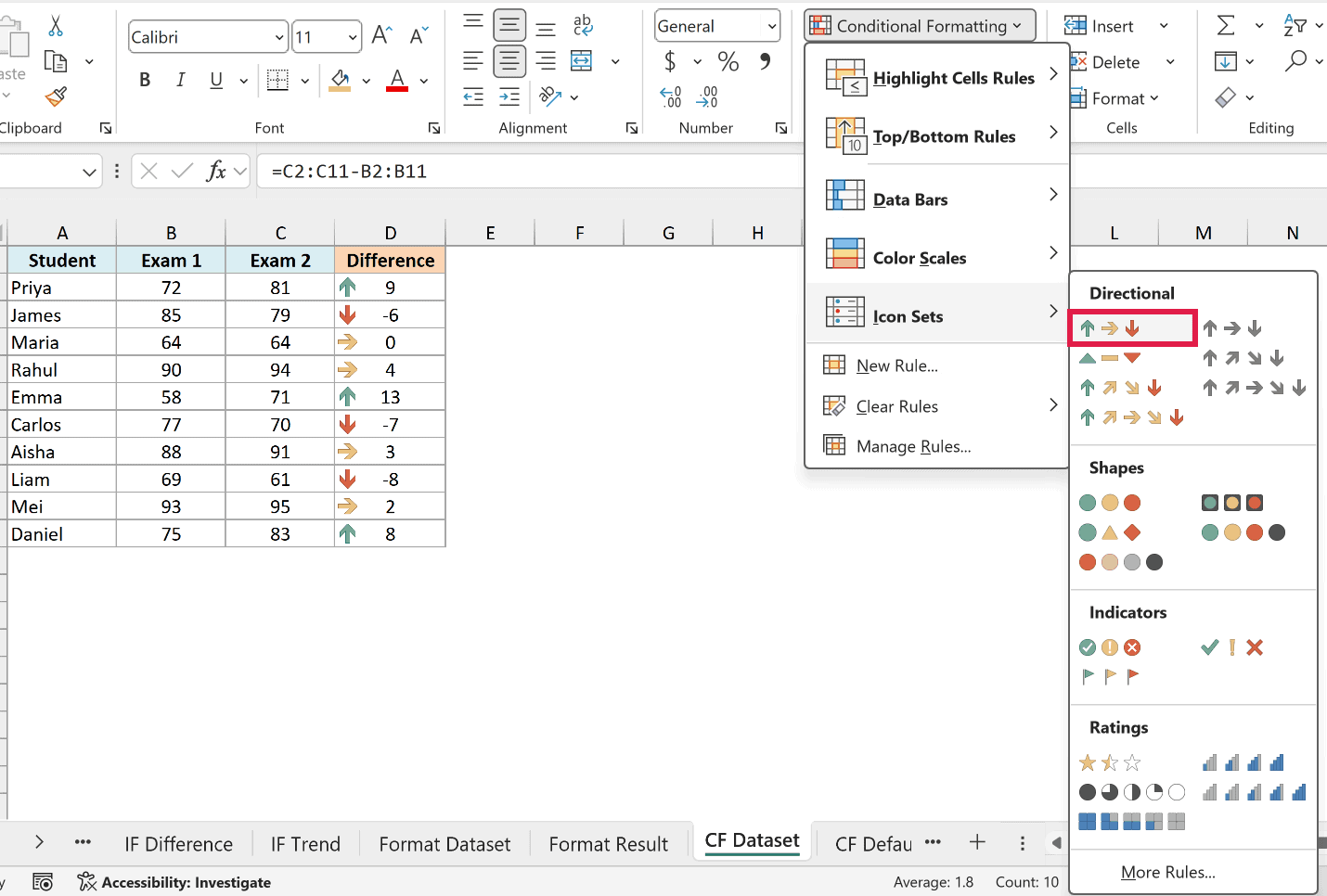
Below is the result that I got where arrows are inserted in column D based on the difference in exam scores.
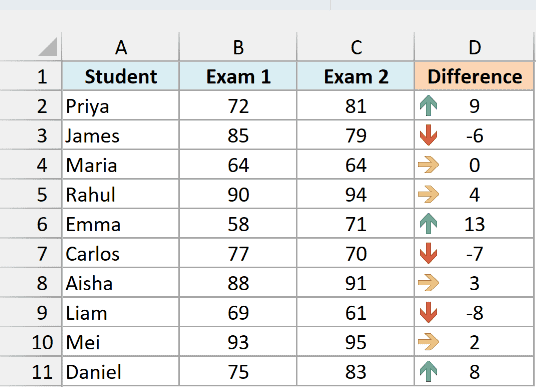
Note that this may not exactly be what you want.
In the above example, Excel considered the highest and lowest values in the difference column, created three tiers of scores, and assigned the arrow accordingly.
The values in the top third of that range get the green arrow, the bottom third get the red arrow, and the rest get the yellow arrow.
That’s why Rahul’s +4 shows a yellow arrow even though his score went up.
If you want to customize it, for example, have the green upward arrow for more than zero and the red downward arrow for a score less than zero, you can do that as well.
Here are the steps to edit the rule:
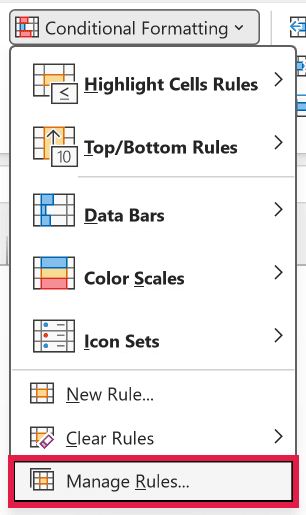
- With D2:D11 still selected, click Conditional Formatting in the Home tab, and then click Manage Rules.
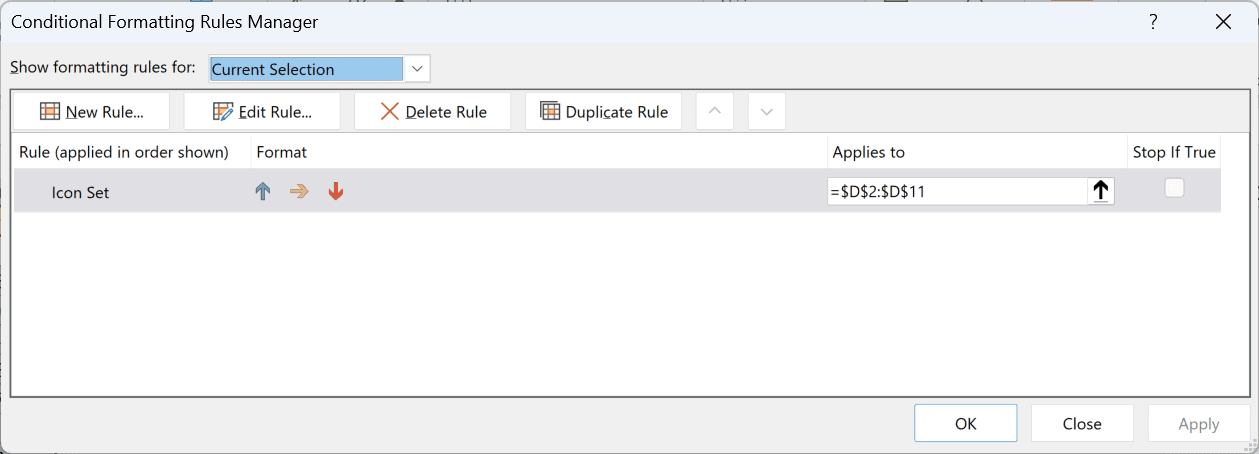
- Select the Icon Set rule and click Edit Rule. This opens the Edit Formatting Rule dialog box.
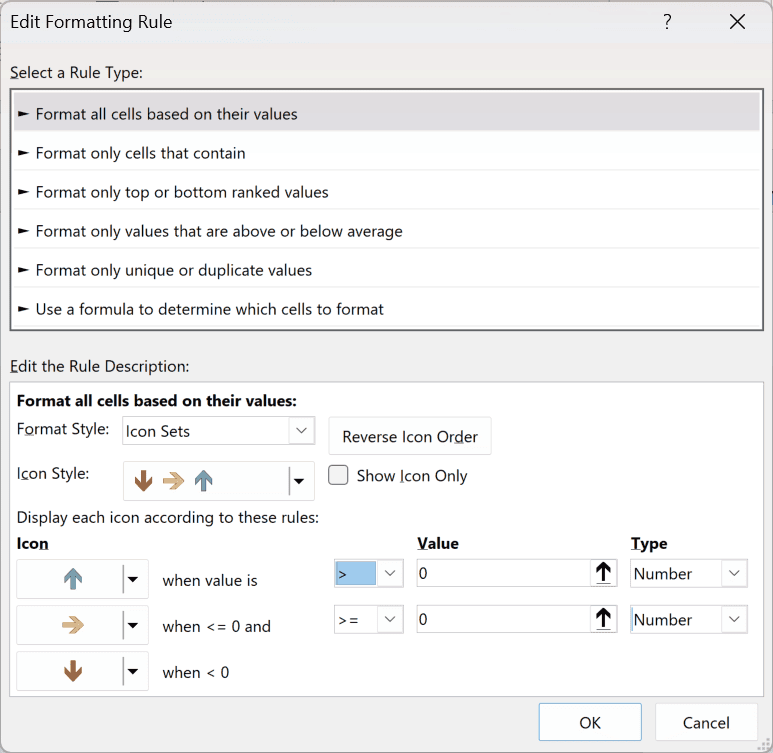
- Change both Type drop-downs to Number. Then set the green arrow to “> 0” and the yellow arrow to “>= 0”.
- Click OK, and then click OK again to close the Rules Manager.
With these settings, every positive difference gets the green up arrow, a zero gets the yellow sideways arrow, and every negative difference gets the red down arrow.
And this is the result I got.
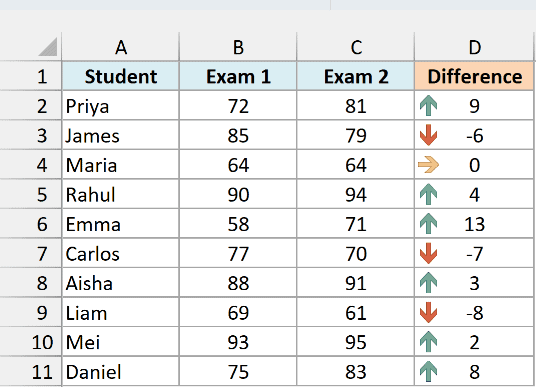
There’s also an option to Show Icon Only in the same dialog box, and if checked, it would hide the values in the cell and only show you the arrows.
So, these are some methods you can use to insert arrows in Excel.
You can insert an arrow symbol in a cell, which is considered like a text character, or insert the arrow shape illustration.
Or you can use conditional formatting to insert arrow icons based on the cell values.
I hope you found this article helpful.
If you know of any other method to insert arrows in Excel or you have any feedback or suggestions for me, please do let me know in the comments section.
Other Excel symbol articles you may also like:
- Insert Symbols in Excel?
- Add Bullet Points in Excel
- Insert Checkmark (Tick Mark) in Excel
- Insert X-Bar Symbol in Excel
- Less Than Or Equal To Symbol in Excel
- Insert the Delta Symbol (Δ) in Excel
- Show Symbols in Drop Down Lists in Excel
Other Excel articles you may also like: