

Below is the written tutorial, in case you prefer reading over watching the video.
In Excel, there are two kinds of tick marks (✓) that you can insert, a check mark and a checkbox.
And no… these are not the same.
Let me explain.
Follow along with the example file
Check Mark in Excel.xlsm
Check Mark Vs Check Box
While a check mark and a checkbox may look somewhat similar, these two are very different in the way they are inserted and used in Excel.
A check mark is a symbol that you can insert in a cell (just like any text that you type).
This means that when you copy the cell, you also copy the check mark, and when you delete the cell, you also delete the check mark.
Just like regular text, you can format it by changing the color and font size.
A checkbox, on the other hand, is something you click to check or uncheck. In Microsoft 365, the new in-cell checkboxes live inside the cell, and the cell holds TRUE when the box is checked and FALSE when it isn’t.
The older Form Control checkboxes are objects that sit above the worksheet. So when you place one over a cell, it’s not a part of the cell, which means it may not get deleted when you delete the cell.
You can also select one of these older checkboxes and drag it anywhere in the worksheet (as it’s not bound to the cell).
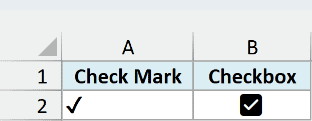
You will find checkboxes being used in interactive reports and dashboards, while a check mark is a symbol that you may want to include as a part of the report.
So a check mark is a symbol in the cell, while a checkbox (which is literally in a box) is something you click to turn on or off.
In this article, I will only be covering check marks. If you want to learn more about checkboxes, here is a detailed tutorial.
There are quite a few ways that you can use to insert a check mark symbol in Excel, and in this article, I will show you all the methods I know.
The method you use would depend on how you want to use the check mark in your work (as you’ll see later in this tutorial). Let’s get started!
Copy and Paste the Check Mark
Starting with the easiest one.
Since you’re already reading this article, you can copy the below check mark and paste it in Excel.
✔
To do this, copy the check mark and go to the cell where you want to paste it. Now either double-click on the cell or press the F2 key, which will take you to the edit mode.
Simply paste the check mark (Control + V).
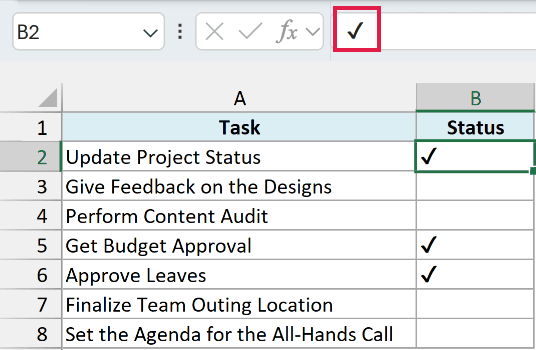
Once you have the check mark in Excel, you can copy it and paste it as many times as you want.
This method is suited when you want to copy paste the check mark in a few places. Since this involves doing it manually, it’s not meant for huge reports where you have to insert check marks for hundreds or thousands of cells based on criteria.
In such a case, it’s better to use a formula (as shown later in this tutorial).
Also read: Insert Pi Symbol (π) in Excel
Check Mark Keyboard Shortcuts (Wingdings Fonts)
For using the keyboard shortcuts, you will have to change the font of the cells to Wingdings 2 (or Wingdings, based on the keyboard shortcut you’re using).
These are symbol fonts, so they show a symbol instead of a letter. For example, a capital P typed in a cell with the Wingdings 2 font shows up as a check mark.
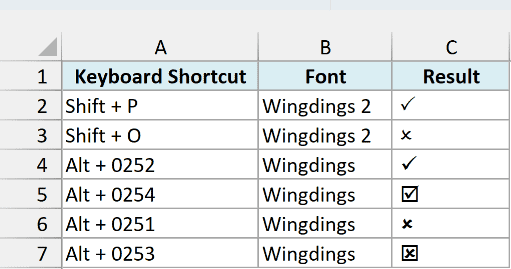
Below are the shortcuts for inserting a check mark or a cross symbol in cells. To use these shortcuts, you need to change the font to Wingdings 2.
| Keyboard Shortcut | Font | Result |
|---|---|---|
| Shift + P | Wingdings 2 | ✓ |
| Shift + O | Wingdings 2 | ✗ |
Below are some more keyboard shortcuts that you can use to insert check mark and cross symbols. To use these, you need to change the font to Wingdings (without the 2).
| Keyboard Shortcut | Font | Result |
|---|---|---|
| Alt + 0252 | Wingdings | ✓ |
| Alt + 0254 | Wingdings | ☑ |
| Alt + 0251 | Wingdings | ✗ |
| Alt + 0253 | Wingdings | ☒ |
To use an Alt code, select the cell, hold the Alt key, type the four digits, and then leave the Alt key.
Important: Type the Alt code digits on the numeric keypad with Num Lock turned on. The number keys above the letters don’t work for Alt codes.
Alt codes only work in Excel on Windows.
This method is best suited when you only want a check mark in the cell.
Since this method requires you to change the font to Wingdings or Wingdings 2, it will not be useful if you want to have any other text or numbers in the same cell with the check mark or the cross mark.
Using the Symbol Dialog Box
Another way to insert a check mark symbol (or any symbol for that matter) in Excel is using the Symbol dialog box.
Here are the steps to insert the check mark (tick mark) using the Symbol dialog box:
- Select the cell in which you want the check mark symbol.
- Click the Insert tab in the ribbon.
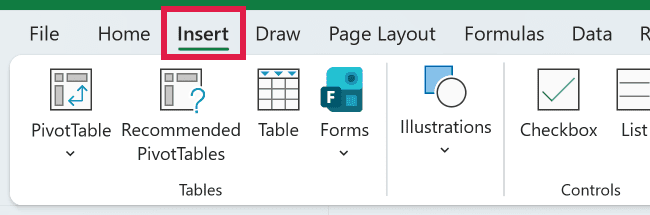
- Click on the Symbol icon (in the Symbols group). If the group is collapsed, click Symbols first.
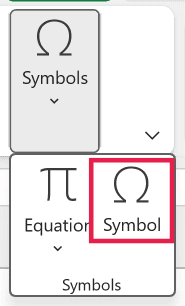
- In the Symbol dialog box that opens, select ‘Segoe UI Symbol’ as the font.
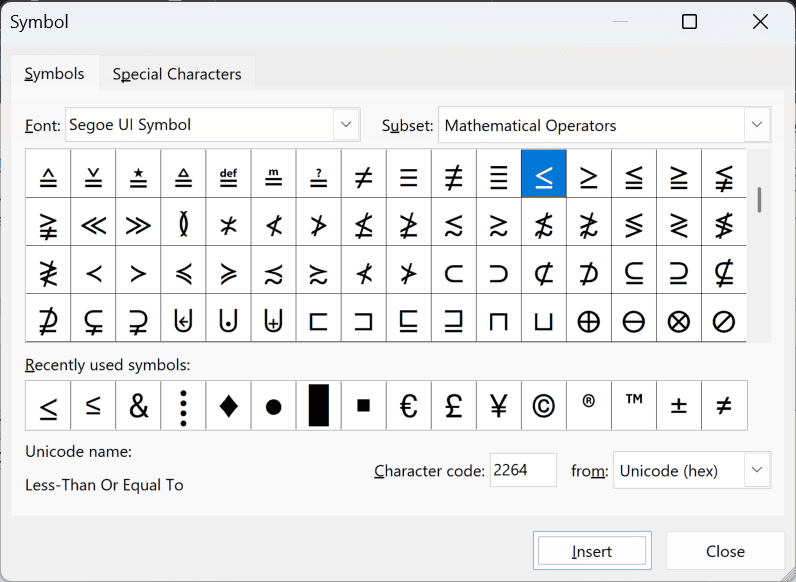
- Scroll down till you find the check mark symbol and then double-click on it (or click on Insert).
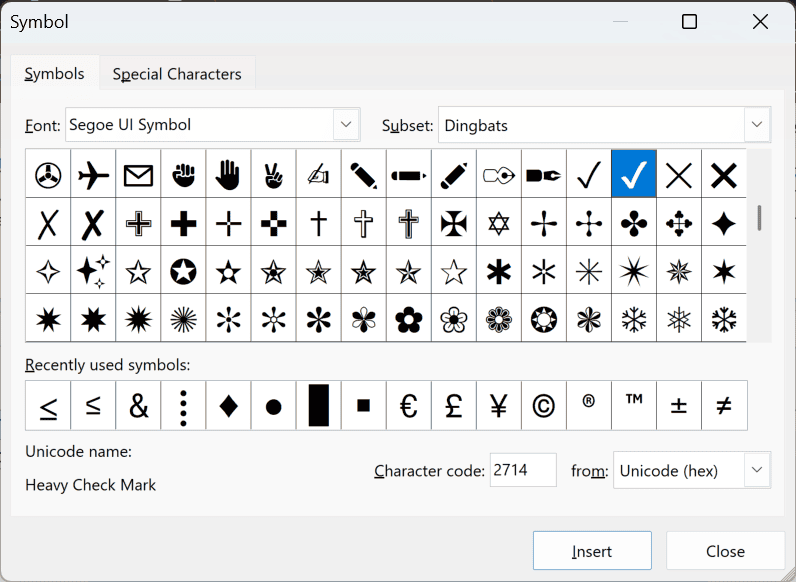
The above steps would insert one check mark in the selected cell. If you want more, simply copy the already inserted one and use it.
Pro Tip: Instead of scrolling, type 2714 in the Character code box at the bottom of the dialog box (with ‘from’ set to Unicode (hex)), and Excel jumps straight to the heavy check mark (✔).
Note that using ‘Segoe UI Symbol’ allows you to use the check mark in any regularly used font in Excel (such as Arial, Times New Roman, Calibri, or Verdana). The shape and size may adjust a little based on the font.
This also means that you can have text or numbers along with the check mark in the same cell.
This method is a bit longer but doesn’t require you to know any shortcut or character code. Once you have used it to insert the symbol, you can reuse that one by copy pasting it.
Also read: Insert Symbol in Excel
Check Mark Symbol Codes (Unicode)
Each check mark and cross mark symbol below has its own Unicode code. You’ll need these codes for the formula and VBA methods that follow.
| Symbol | Name | Unicode | UNICHAR Code |
|---|---|---|---|
| ✓ | Check Mark | U+2713 | 10003 |
| ✔ | Heavy Check Mark | U+2714 | 10004 |
| ✅ | White Heavy Check Mark | U+2705 | 9989 |
| ☑ | Ballot Box with Check | U+2611 | 9745 |
| ✗ | Ballot X | U+2717 | 10007 |
| ✘ | Heavy Ballot X | U+2718 | 10008 |
| ☒ | Ballot Box with X | U+2612 | 9746 |
In the Unicode column, the part after U+ (for example 2714 for ✔) is what you type in the Character code box of the Symbol dialog box.
The UNICHAR Code column is that same code written as a regular number (2714 becomes 10004), and that’s the number the UNICHAR function needs.
There’s no check mark in the ASCII character set (it only covers basic English letters, numbers, and punctuation). That’s why you’ll see either a Unicode code or a Wingdings font being used to get one.
The ✅ (9989) is an emoji, so how it looks in your workbook depends on your font and Excel version.
Check Mark Formula Using UNICHAR
You can use the UNICHAR function to return a check mark (or a cross mark) with a formula. For example, =UNICHAR(10004) returns ✔, and =UNICHAR(10008) returns ✘.
Below I have the check mark codes from the table above in column C, and I want to show the symbol for each code in column D.
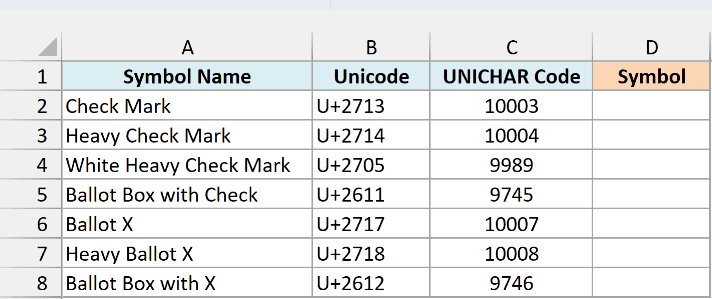
Here is the formula:
=UNICHAR(C2:C8)
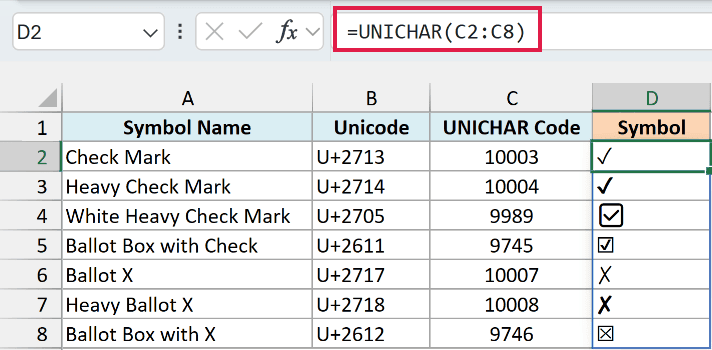
UNICHAR reads each code in C2:C8 and returns its character, and the results spill down to D8 automatically.
These are regular Unicode characters, so they show up in any font. You don’t need to change the font of the cell, and you can have text in the same cell (for example ="Done "&UNICHAR(10004)).
If you are using Excel 2019 or earlier, enter the below formula in cell D2 and then copy it down the range:
=UNICHAR(C2)
The UNICHAR function works in Excel 2013 and later, including 365, 2024, 2021, 2019, 2016, Mac, and the web.
If you want to learn more about this function, here is my guide on the UNICHAR function.
Using the CHAR Formula (Wingdings)
Before UNICHAR, the usual way to get a check mark with a formula was the CHAR function along with the Wingdings font, and it still works.
=CHAR(252) returns a check mark, but for this to work, you need to convert the font of the cell to Wingdings.
Why?
Because when you use the CHAR(252) formula, it gives you the ANSI character (ü), and when you change the font to Wingdings, it shows up as a check mark.
You can use similar CHAR formulas (with a different code number) to get another format of the check mark or the cross mark.
Below I have four Wingdings codes in column A, and I want to show the symbol for each one in column B, which uses the Wingdings font.
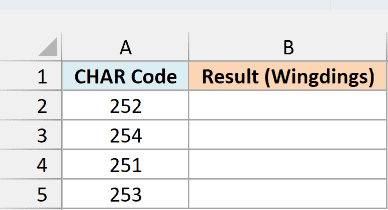
Here is the formula:
=CHAR(A2:A5)
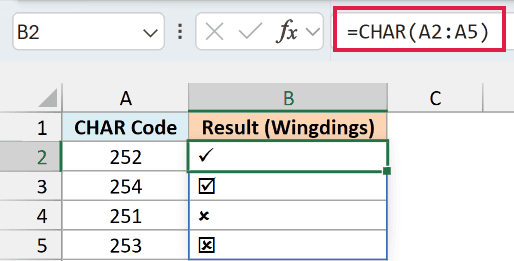
CHAR(252), CHAR(254), CHAR(251), and CHAR(253) return ü, þ, û, and ý, and the Wingdings font in column B turns them into a check mark, a checked box, a cross mark, and a crossed box.
If you are using Excel 2019 or earlier, enter the below formula in cell B2 and then copy it down the range:
=CHAR(A2)
Since the cells need the Wingdings font, you can’t have anything else in them except the symbol. If you type regular text in a Wingdings cell, it shows up as symbols too.
Also, Microsoft’s documentation says CHAR uses the Macintosh character set on a Mac, so these codes may not give you the same symbols there. UNICHAR doesn’t have this problem.
Show a Check Mark or Cross Mark Based on a Cell Value
The real benefit of using a formula is when you use it with other formulas and return the check mark or the cross mark as the result.
Below is a dataset of store sales, and I want to show a check mark in column C if the sales are 5,000 or more, and a cross mark if they’re less.
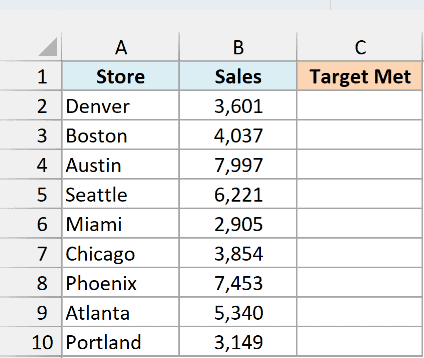
You can use the below IF formula to do this:
=IF(B2:B10>=5000,UNICHAR(10004),UNICHAR(10008))
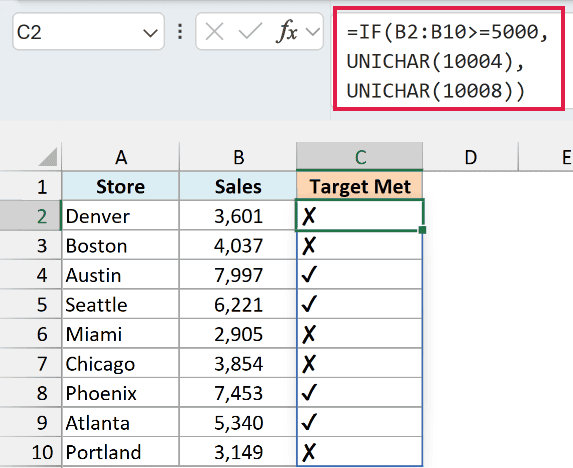
The IF function checks each sales value in B2:B10. When it’s 5,000 or more, it returns UNICHAR(10004), which is ✔, and otherwise it returns UNICHAR(10008), which is ✘.
The results spill down to C10 on their own, so you don’t need to copy the formula.
Showing a check mark or a cross mark instead of a number helps you make your reports a little more visual, and it also works well with printed reports.
If you are using Excel 2019 or earlier, enter the below formula in cell C2 and then copy it down the range:
=IF(B2>=5000,UNICHAR(10004),UNICHAR(10008))
If you’d rather use the Wingdings version from the previous section, here is the same formula with CHAR, which I have used in column D:
=IF(B2:B10>=5000,CHAR(252),CHAR(251))
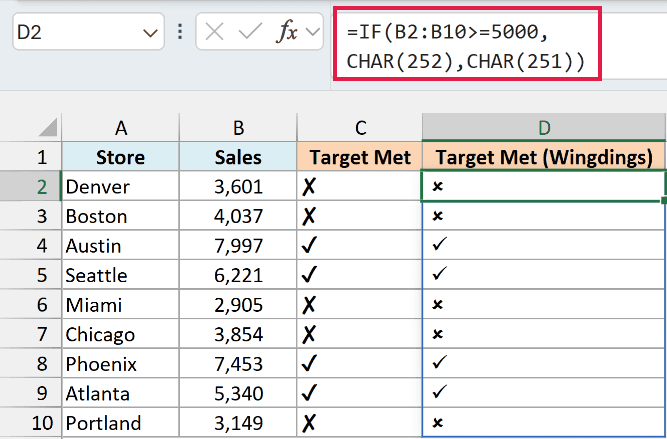
Remember, you need to convert the column font to Wingdings for this one, or you’ll see ü and û instead of the symbols.
If you are using Excel 2019 or earlier, enter the below formula in cell D2 and then copy it down the range:
=IF(B2>=5000,CHAR(252),CHAR(251))
If you want to remove the formula and only keep the values, copy the cells and paste them as values (right-click, go to Paste Special, and click on the Values icon).
This method is suited when you want the check mark insertion to be dependent on cell values. Since this uses a formula, you can use it even when you have hundreds or thousands of cells.
Using AutoCorrect
Excel has a feature where it can autocorrect misspelled words automatically.
For example, type the word ‘bcak’ in a cell in Excel and see what happens. It will automatically correct it to the word ‘back’.
This happens as there is already a pre-made list of expected misspelled words you’re likely to type, and Excel automatically corrects it for you. You can add your own entry to this list, so a code word you type gets replaced with a check mark.
Here are the steps to use autocorrect to insert the check mark symbol:
- Click on the File tab, and then click on Options.
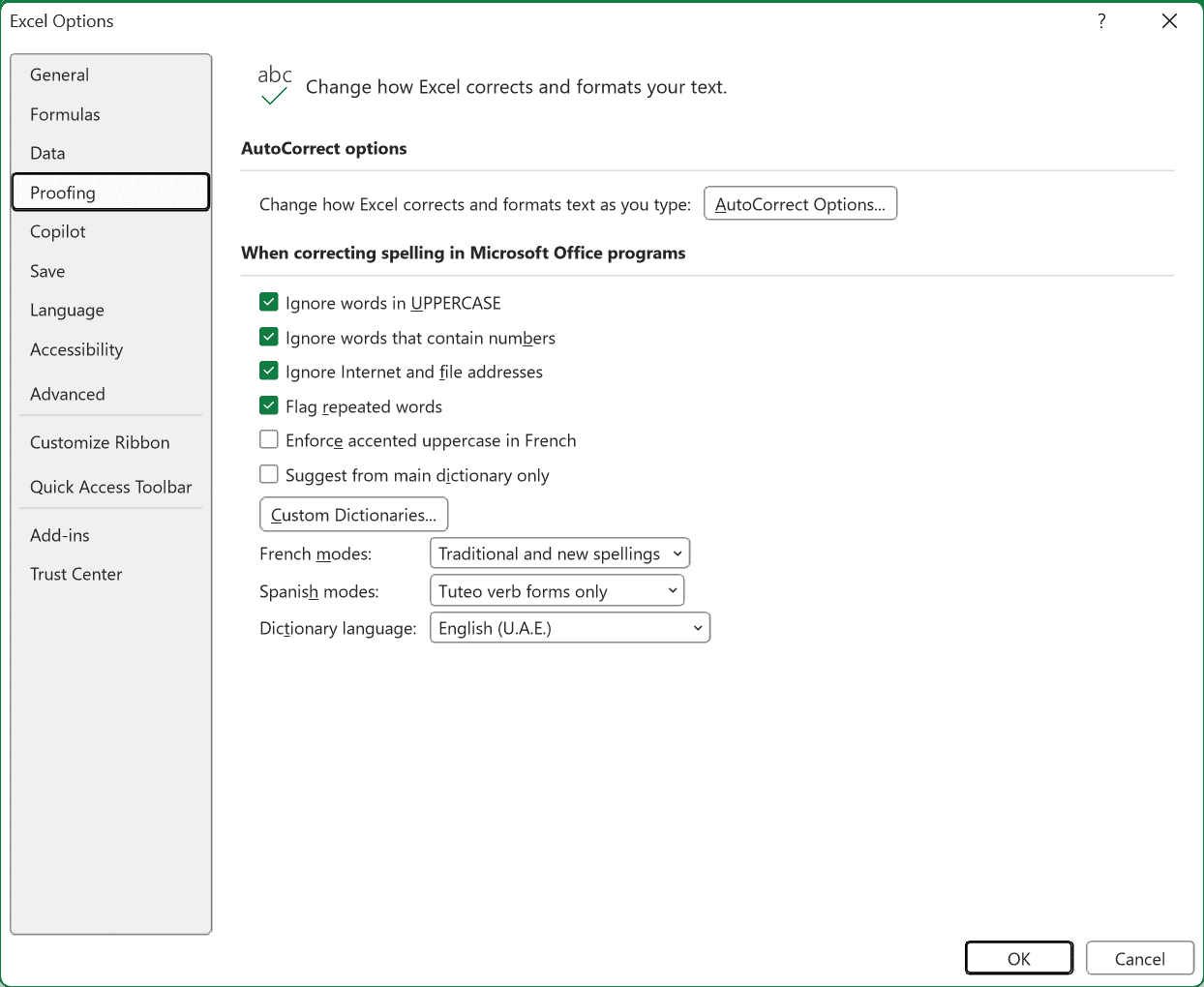
- In the Excel Options dialog box, select Proofing.
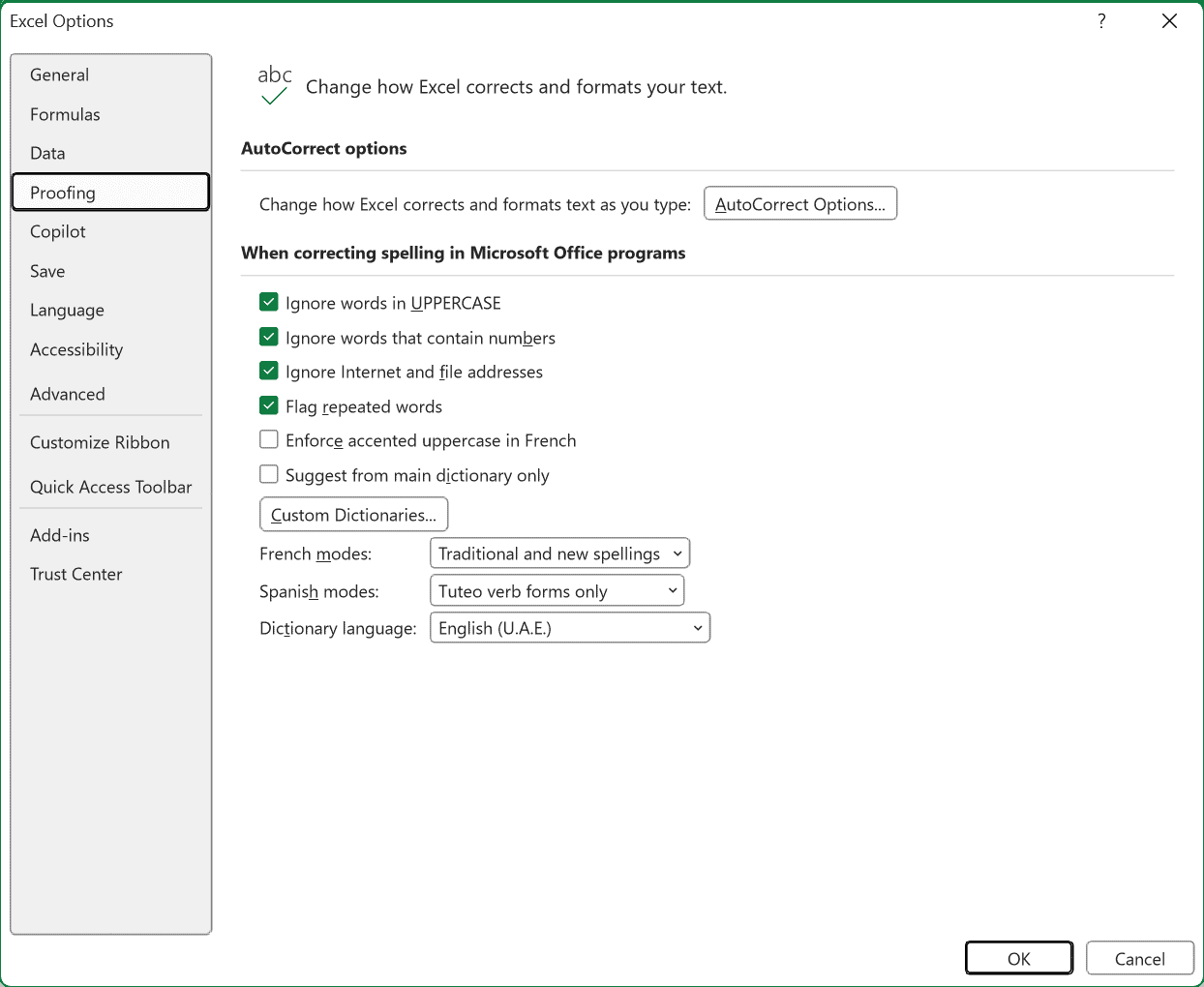
- Click on the ‘AutoCorrect Options’ button.
- In the AutoCorrect dialog box, enter CMARK in the Replace field and ✔ in the With field (you can copy and paste this).
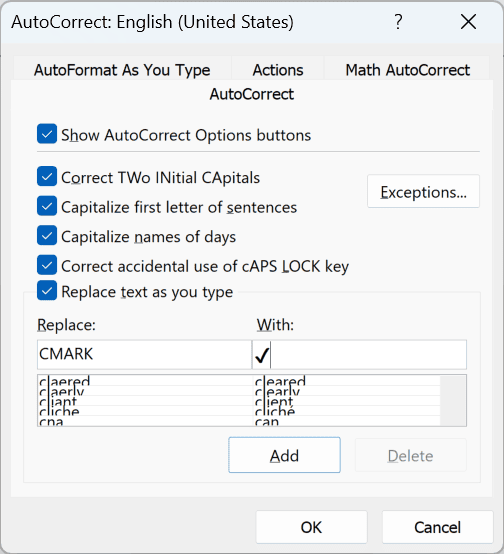
- Click Add and then OK.
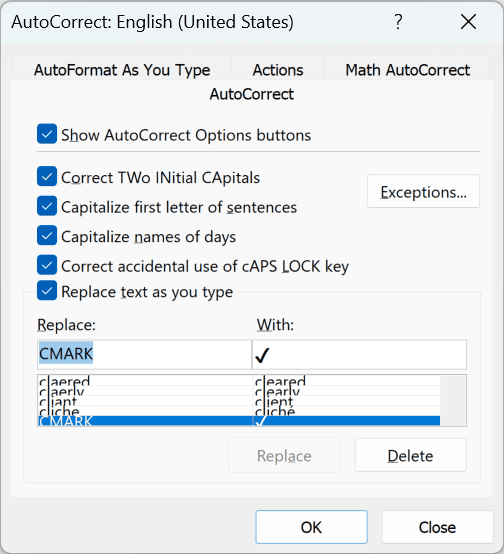
Now whenever you type the word CMARK followed by a space in a cell in Excel, it will automatically change it to a check mark.
Here are a few things you need to know when using the AutoCorrect method:
- This is case sensitive. So if you enter ‘cmark’, it will not get converted into the check mark symbol. You need to enter CMARK.
- This change also gets applied to all the other Microsoft applications (MS Word, PowerPoint, etc.). So be cautious and choose a keyword that you are highly unlikely to use in any other application.
- If there is any text or number right before or after CMARK, it will not be converted to the check mark symbol. For example, ‘38%CMARK’ will not get converted, however, ‘38% CMARK ‘ (with a space after it) will get converted to ‘38% ✔’.
Related Tutorial: Excel Autocorrect
This method is suited when you want a ready reference for the check mark and you use it regularly in your work.
So instead of remembering the shortcuts or using the symbols dialog box, you can quickly use the shortcode name that you have created for the check mark (or any other symbol for that matter).
Follow along with the example file
Check Mark in Excel.xlsm
Using Conditional Formatting to Insert Check Mark
You can use conditional formatting to insert a check mark or a cross mark based on the cell value.
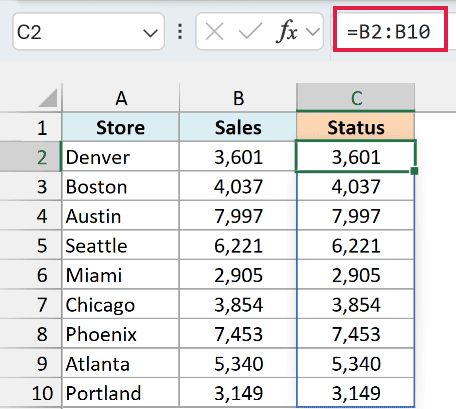
Below is a dataset of store sales, and I want to show a check mark in column C if the sales are 5,000 or more, and a cross mark if they’re less.
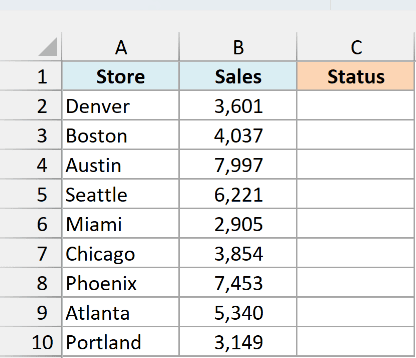
The icons will replace the numbers in the cells they’re applied to, so we’ll first copy the sales into column C. That way, the original numbers stay visible in column B.
Here are the steps to do this using conditional formatting:
- In cell C2, enter =B2:B10. This gives you the same values in column C, and if you change a value in column B, it automatically changes in column C.
If you are using Excel 2019 or earlier, enter the below formula in cell C2 and then copy it down to C10:
=B2
- Select the cells in column C (C2:C10) in which you want the check marks.
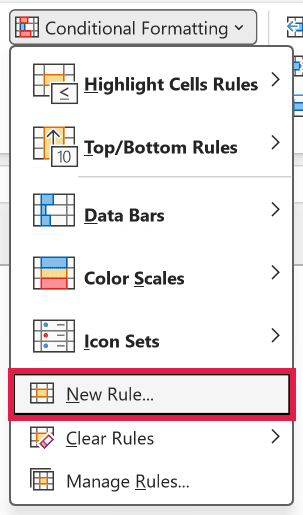
- Click the Home tab, then click on Conditional Formatting, and then click on New Rule.
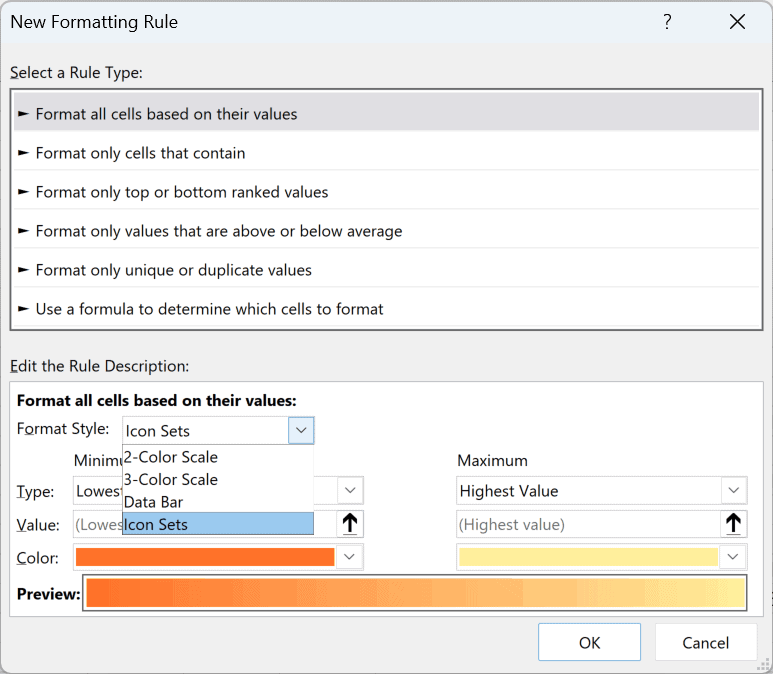
- In the ‘New Formatting Rule’ dialog box, click on the ‘Format Style’ drop-down and select ‘Icon Sets’.
- In the ‘Icon Style’ drop-down, select ‘3 Symbols (Uncircled)’, which has the check mark and the cross mark.
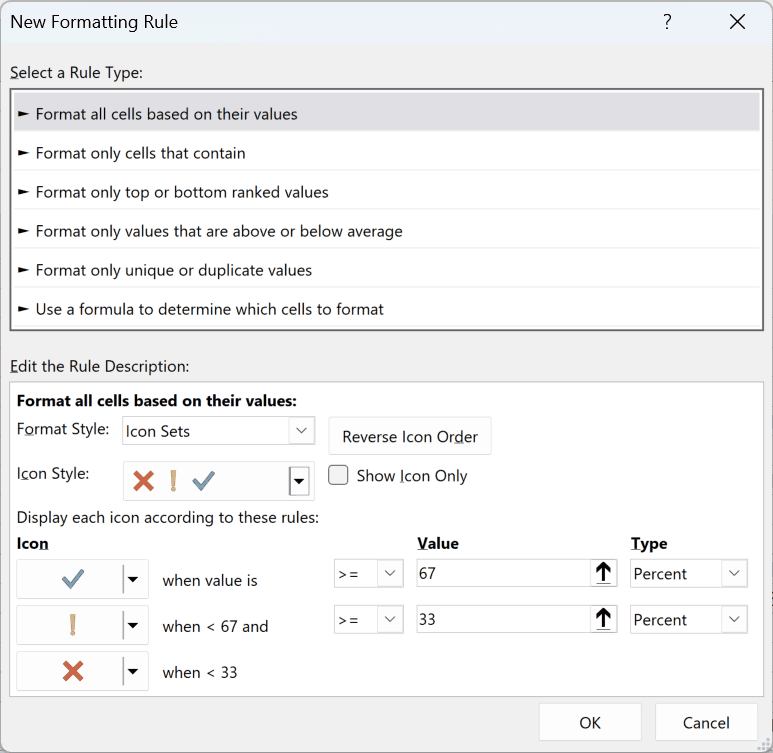
- Check the ‘Show Icon Only’ box. This will ensure that only the icons are visible and the numbers are hidden.
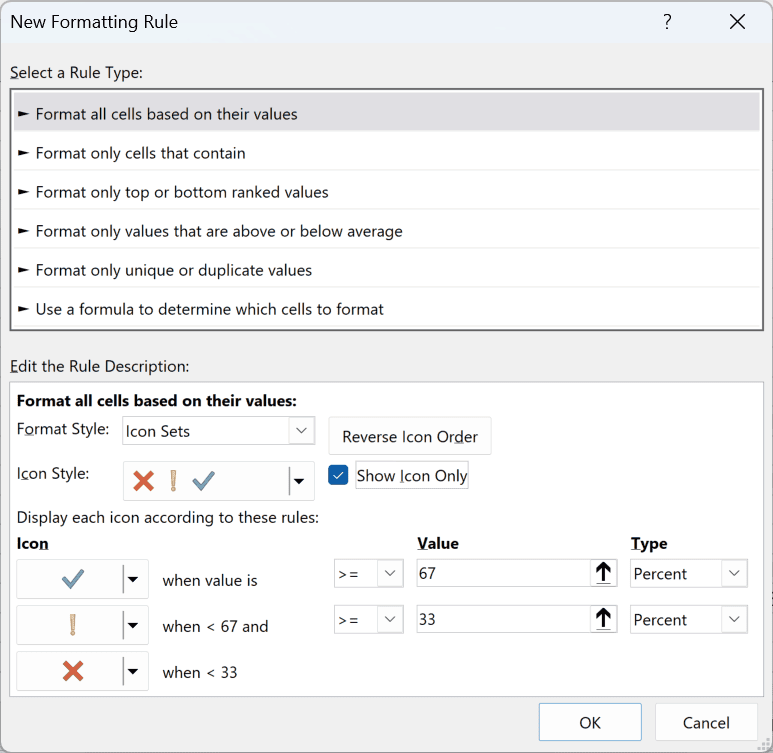
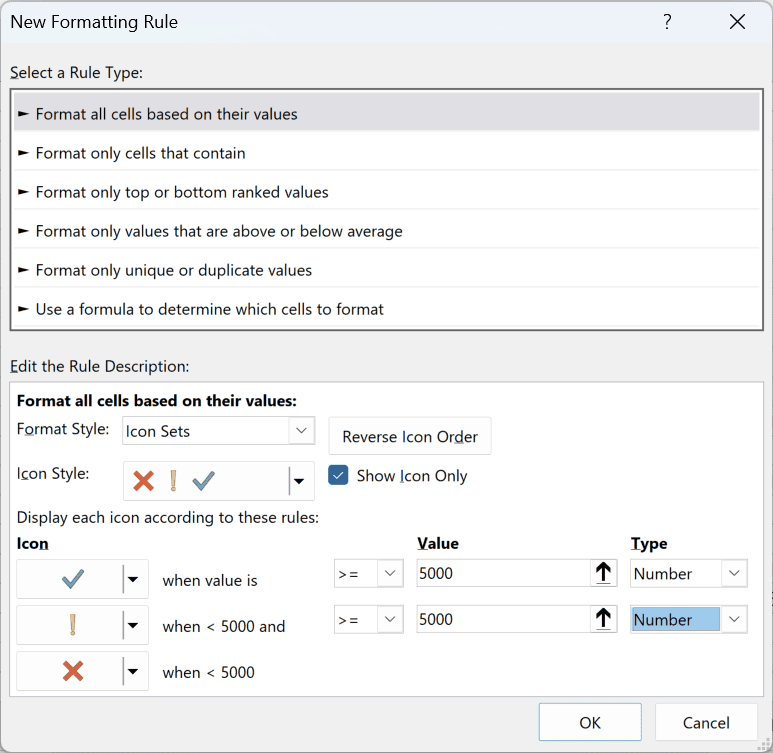
- The dialog box shows three icon rows. In the first two rows (the ones with Value boxes), change the Type from ‘Percent’ to ‘Number’ and enter 5000 as the Value.
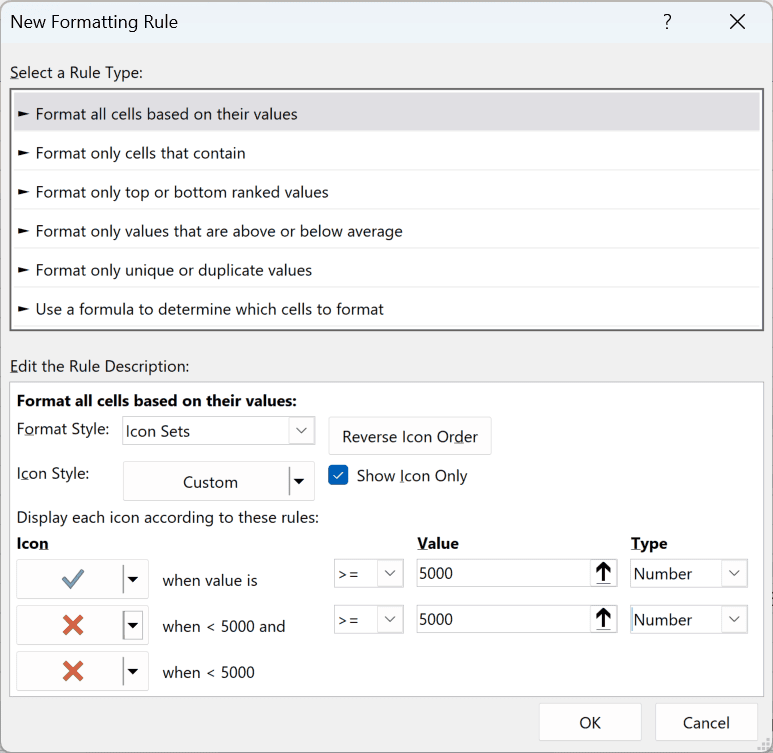
- Click the icon drop-down in the second row and select the red cross mark.
- Click OK.
The above steps will insert a green check mark whenever the value is more than or equal to 5000 and a red cross mark whenever the value is less than 5000.
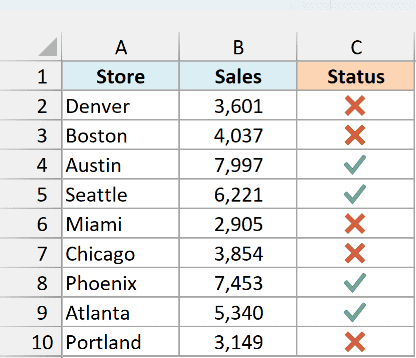
The red cross in the third row is what shows up for values below 5000.
Since the first two rows both use 5000, the second row’s icon never shows up here. Changing it to the red cross is a safeguard, so you still get a cross (not a yellow mark) if you later change one of the rule’s 5000 values.
In this case, I have only used these two icons, but you can also use the yellow exclamation mark as well if you want (keep the yellow exclamation mark as the second row’s icon and give that row a lower value than the first).
Also read: Insert Arrows in Excel
Follow along with the example file
Check Mark in Excel.xlsm
Insert a Check Mark with a Double-Click (VBA)
With a little bit of VBA code, you can create an awesome functionality, where it inserts a check mark as soon as you double click on a cell, and removes it if you double click again.
Something as shown below (the red ripple indicates a double click):
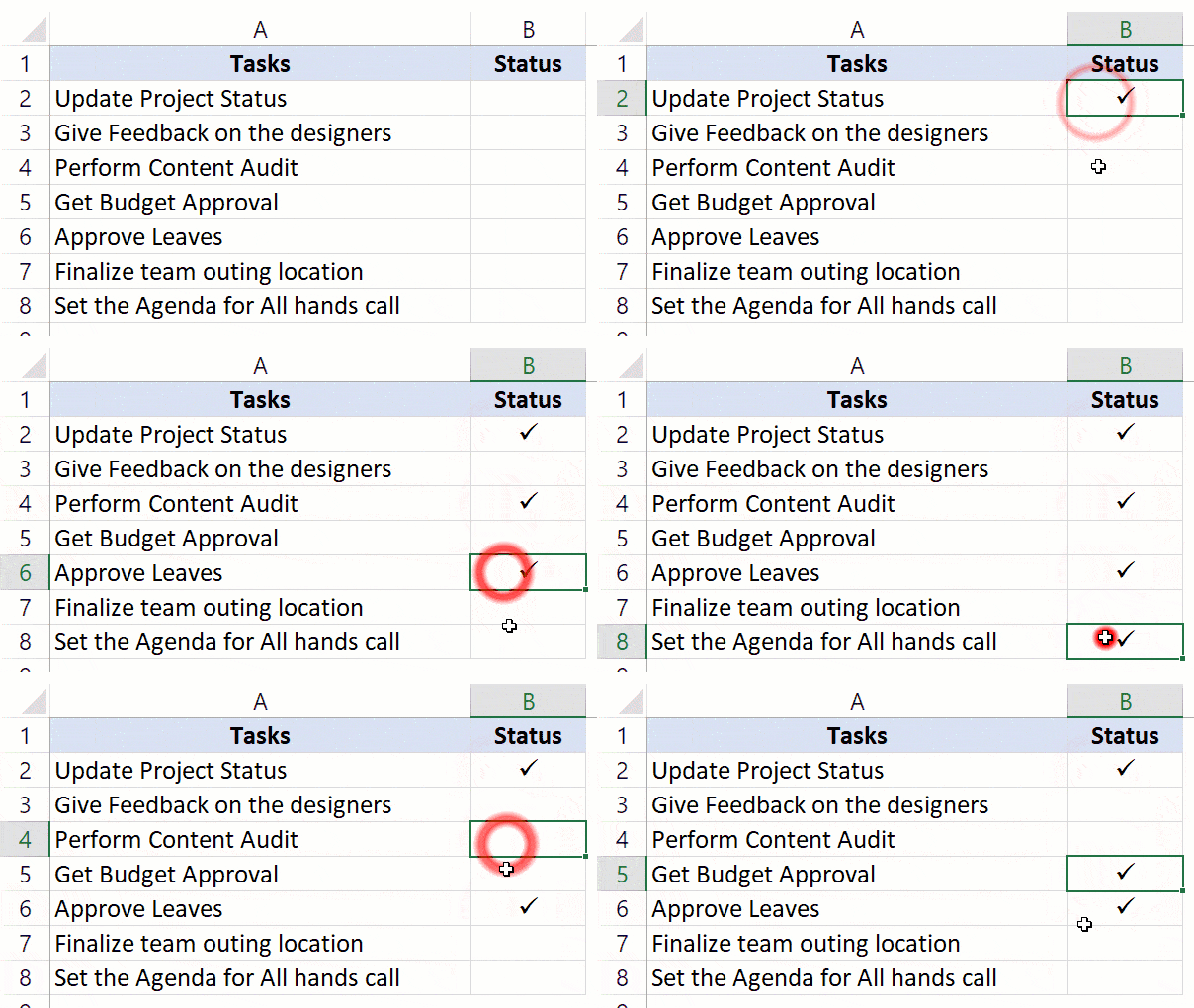
To do this, you need to use the VBA double-click event and a simple VBA code.
But before I give you the full code to enable double click, let me quickly explain how VBA can insert a check mark. The below code inserts a check mark in the selected cell.
'Code created by Sumit Bansal from https://trumpexcel.com/
'Inserts a check mark in the selected cell
Sub InsertCheckMark()
    ActiveCell.Value = ChrW(10004)
End SubChrW(10004) is the VBA version of UNICHAR(10004), so it gives you the ✔ character, and the cell doesn’t need the Wingdings font.
To use this one, put it in a regular module (in the VB Editor, click Insert and then Module). Then select a cell, press Alt + F8 to open the Macro dialog box, select InsertCheckMark, and click Run.
Now I will use the same concept to insert a check mark on double click.
Below is the code to do this:
'Code created by Sumit Bansal from https://trumpexcel.com/
'Double-click a cell in column B to add a check mark, double-click again to remove it
Private Sub Worksheet_BeforeDoubleClick(ByVal Target As Range, Cancel As Boolean)
    If Target.Column = 2 And Target.Row > 1 Then
        Cancel = True
        If Target.Value = "" Then
            Target.Value = ChrW(10004)
        Else
            Target.Value = ""
        End If
    End If
End SubThis code works on column B (the Status column in the example file) and skips the header row. Cancel = True stops Excel from going into edit mode when you double-click.
If you want it in a different column, change the 2 in Target.Column = 2 to that column’s number (3 for column C, 4 for column D, and so on).
You need to copy and paste this code in the code window of the worksheet in which you need this functionality. To open the worksheet code window, right-click on the sheet name in the tabs and click on ‘View Code’.
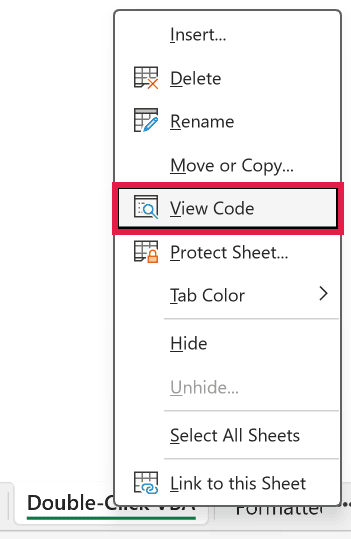
Important: Save the workbook as an Excel Macro-Enabled Workbook (.xlsm). If you save it as a regular .xlsx file, Excel removes the code.
This is a good method when you need to manually scan a list and insert check marks. You can easily do this with a double click.
The best use case of this is when you’re going through a list of tasks and have to mark it as done or not. If you’re on Microsoft 365, an in-cell checkbox can do this job with a single click and no VBA.
Formatting the Check Mark Symbol
A check mark is just like any other text or symbol that you use.
This means that you can easily change its color and size.
All you need to do is select the cells that have the symbol and apply the formatting such as font size, font color, and bold etc.
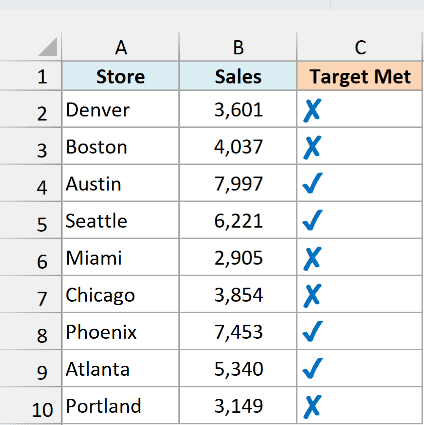
This way of formatting symbols is manual and suited only when you have a couple of symbols to format. If you have a lot of these, it’s better to use conditional formatting to format these (as shown in the next section).
Format Check Mark / Cross Mark Using Conditional Formatting
With conditional formatting, you can format the cells based on what type of symbol they have.
Below is an example:
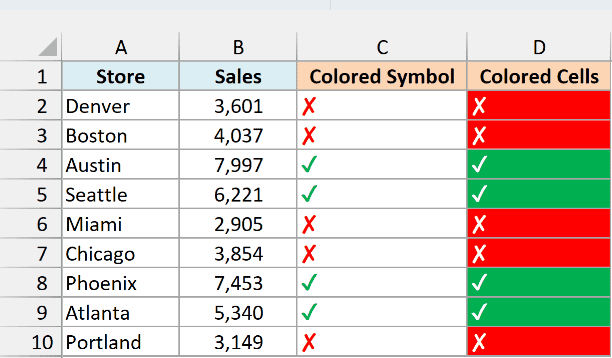
Both column C and column D use the UNICHAR IF formula from the earlier section to return a check mark if the sales are 5,000 or more and a cross mark if they’re less.
Conditional formatting then colors only the symbol in column C and the whole cell in column D, which looks way better than plain symbols.
Let’s see how you can do this.
Below is the same store sales dataset with the UNICHAR IF formula in columns C and D, and I want to color the cells in column D based on the symbol they have.
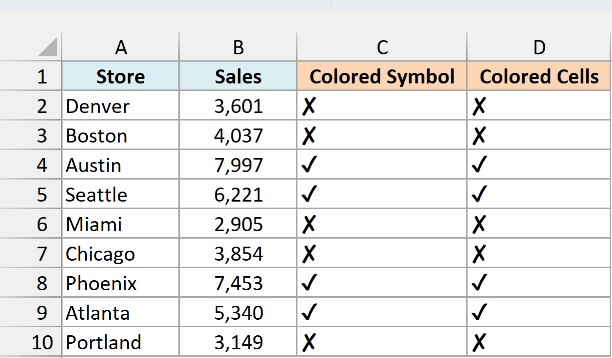
Below are the steps to color the cells based on the symbol they have:
- Select the cells that have the check mark / cross mark symbols (D2:D10).
- Click the Home tab, then click on Conditional Formatting, and then click on ‘New Rule’.
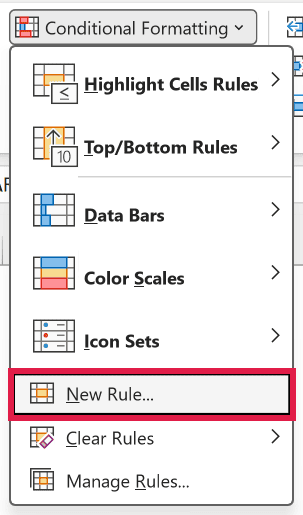
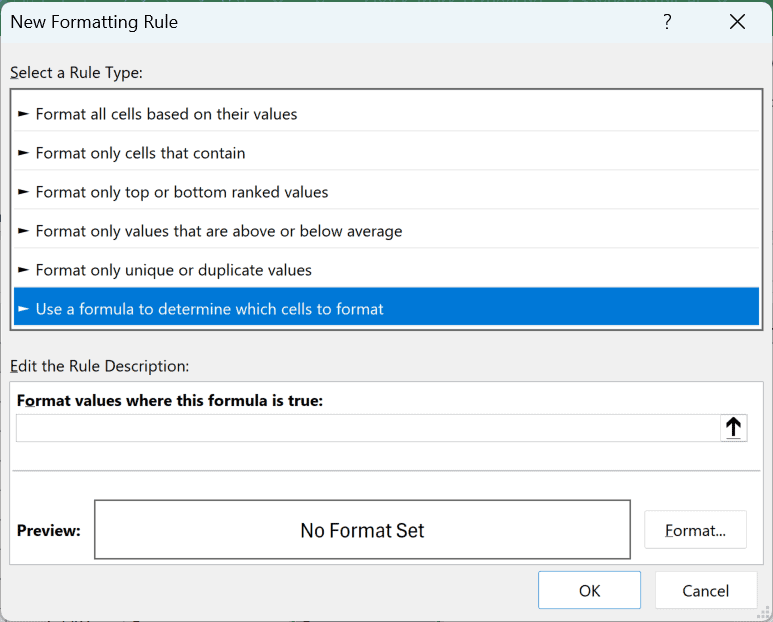
- In the New Formatting Rule dialog box, select ‘Use a formula to determine which cells to format’.
- In the formula field, enter the following formula: =D2=UNICHAR(10004)
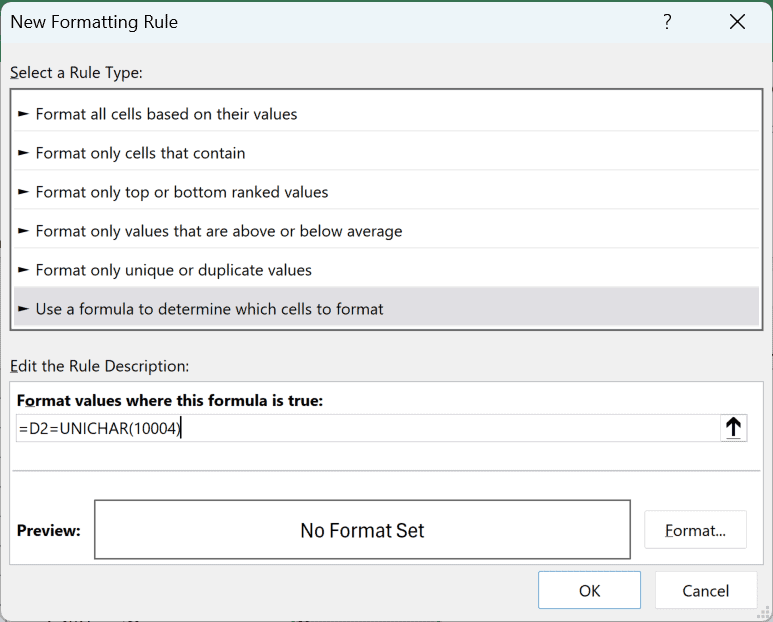
- Click the Format button.
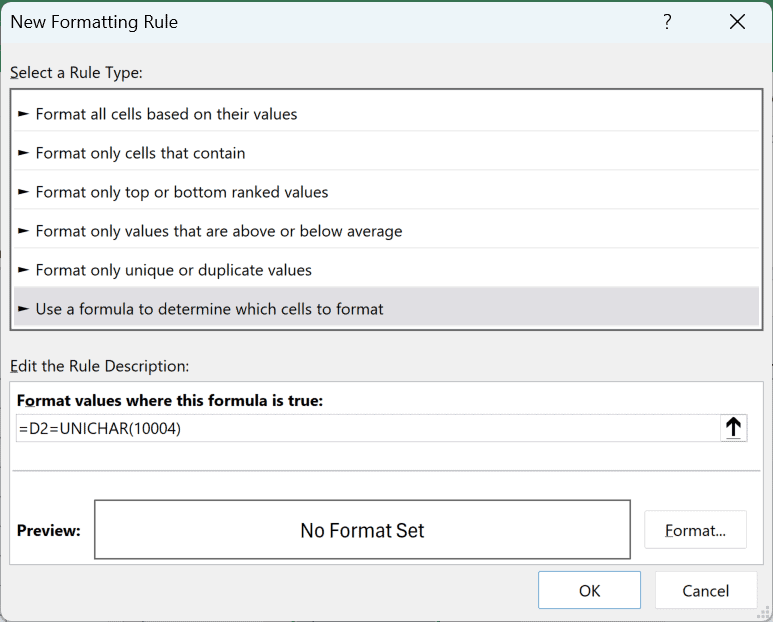
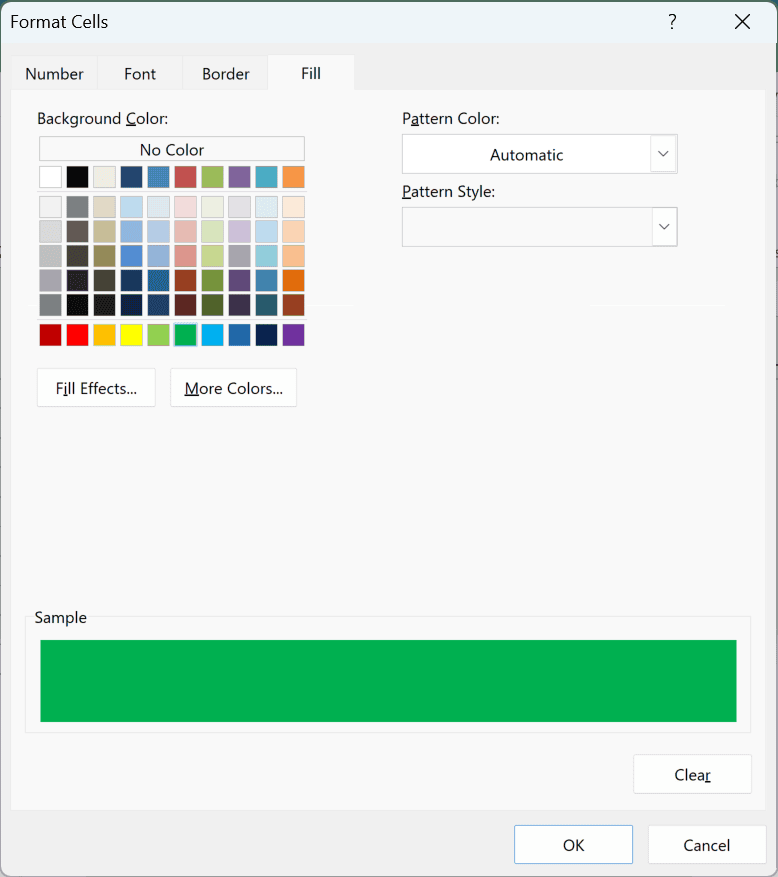
- In the ‘Format Cells’ dialog box, go to the Fill tab and select the green color.
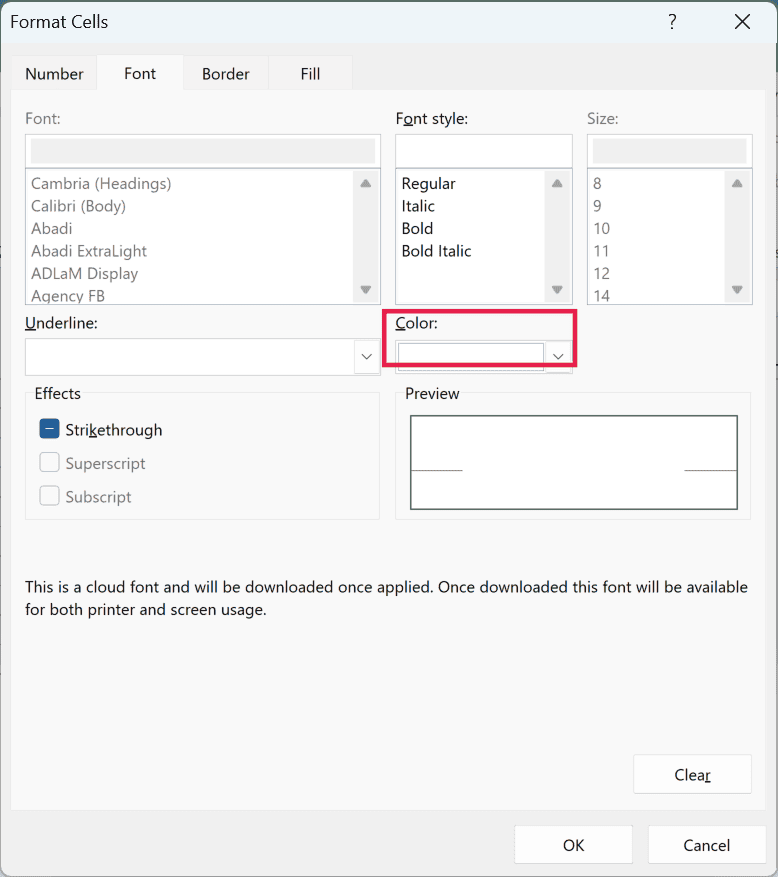
- Go to the Font tab and select white as the color (this is to make sure your check mark looks nice when the cell has a green background color).
- Click OK in the Format Cells dialog box, and then click OK in the New Formatting Rule dialog box.
After the above steps, all the cells that have the check mark will be colored in green with white font.
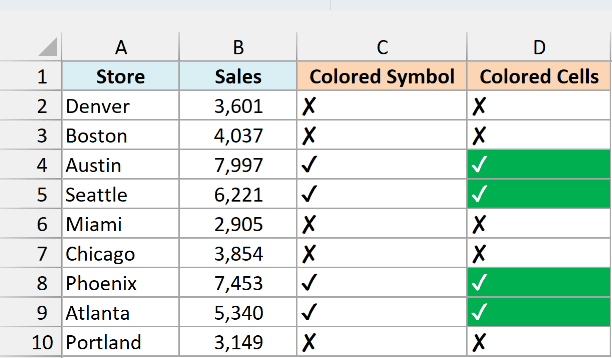
You need to repeat the same steps to now format the cells with a cross mark. Change the formula to =D2=UNICHAR(10008) in step 4, and select the red color instead of green in step 6.
To color only the symbol (like column C), select C2:C10, use the same two formulas with C2 instead of D2, and only change the color in the Font tab (green for the check mark and red for the cross mark).
If your check marks come from the CHAR(252) formula with the Wingdings font, use =D2=CHAR(252) and =D2=CHAR(251) as the formulas instead.
Count Check Marks in Excel
If you want to count the total number of check marks (or cross marks), you can do that using a combination of COUNTIF and UNICHAR.
For example, below is a dataset of store sales with a check mark in column C for every store that achieved the sales target, and I want to get the total number of these stores in cell C12.
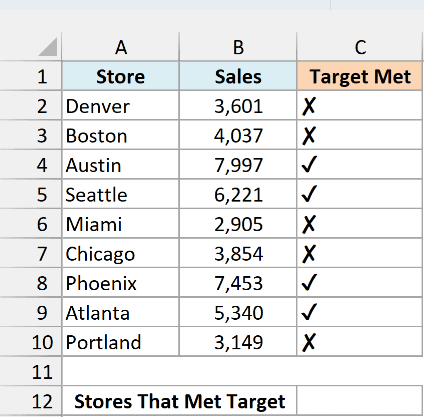
Below is the formula that will give you the total number of check marks in column C:
=COUNTIF(C2:C10,UNICHAR(10004))
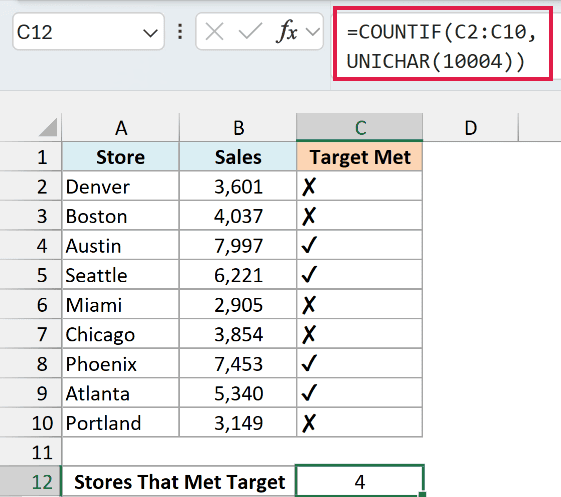
COUNTIF counts the cells in C2:C10 that are equal to UNICHAR(10004), which is ✔, and it returns 4 here. To count the cross marks instead, use UNICHAR(10008).
Note that this formula relies on you using the same check mark that the formula is looking for. A lighter check mark (✓, which is UNICHAR(10003)) is a different character, so the above COUNTIF function is not going to count it.
The same applies to Wingdings check marks. If you have used the keyboard shortcut ALT 0252, the formula =CHAR(252), or copied and pasted a check mark created using these methods, use =COUNTIF(C2:C10,CHAR(252)) instead.
So these are some of the methods you can use to insert a check mark in Excel. You can insert it as a symbol, get it with a formula, show it with conditional formatting, or add it with a double-click using VBA.
I hope you found this Excel tutorial useful.
Other Excel Articles You May Also Like:

ALT+0252 = ü
ALT +0254 = þ
Thanks for the wrong codes.
You didn’t change the font to Wingdings. Change the font and it will work
hello,
thank you for this tutorial…. but i want to apply this double click form column 7-50…….. can you help me how?
thank you very much
Now I will use the same concept to insert a check mark on double click.
Below is the code to do this:
Private Sub Worksheet_BeforeDoubleClick(ByVal Target As Range, Cancel As Boolean)
If Target.Column = 2 Then
Cancel = True
Target.Font.Name = “Wingdings”
If Target.Value = “” Then
Target.Value = “ü”
Else
Target.Value = “”
End If
End If
End Sub
If I want use the VBA code for more than one column how do I adjust the coding to double click and add the check mark for let’s day columns 7, 8 and 9?
thank you
useful
Thank you so much…very detailed and informative
Thanks, really helpful. As per other comments – how do you modify the code to include multiple columns or multiple ranges?
I would like to use the VBA code for more than one column at once. How do I adjust the coding to double click and add the check mark to other columns as well?
Excellent – thank you! One question: in the VBA version: how can I have the target column as several columns; not just one please?
Thanks in advance
Wow great job. worked well.
If I want use the VBA code for more than one column how do I adjust the coding to double click and add the check mark for let’s day columns 7, 8 and 9?
Hi,
When I’m trying to protect the sheet, it doesn’t allow me to check/uncheck the cells. It says: “Run-time error 1004. Unable to set the Name property of the Font class.” If I click Debug, it highlights the following piece of code:
Target.Font.Name = “Wingdings”
Please note I’ve unlocked the cells before protecting the sheet.
Please let me know if there is a way to solve this issue 🙁
You truly are an expert brother!
Very comprehensive-Thank you. Please note that the CHAR function may depend on the language settings of windows (I guess so at least).
cool…
How you doing
Muy interesante!!!
Thanks lot to share the excel tips.
thank you alot