

When you have a big dataset with blank cells scattered through it, manually clicking each one is a waste of time.
Excel has a few quick ways to grab every blank cell at once so you can fill them, delete them, format them, or do whatever else you need.
In this article, I’ll show you four ways to select blank cells in Excel, including a keyboard shortcut that does it in seconds.
Select Blank Cells Using Go To Special (Shortcut Method)
Let’s start with the fastest way to select blank cells in Excel.
This uses the built-in Go To Special feature, and you can pull it up with a keyboard shortcut.
Below is a dataset with blank cells that need to be selected.
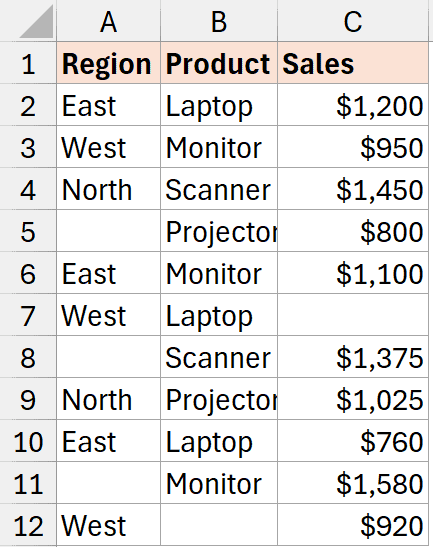
Here are the steps to select all the blank cells using Go To Special:
- Select the range that contains the blank cells (in this example, A2:C12)
- Press the F5 key (or Ctrl + G) to open the Go To dialog box
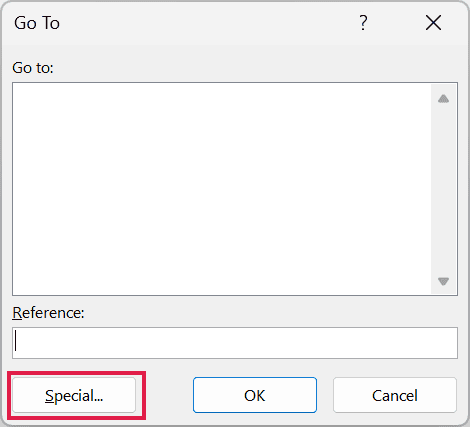
- Click the Special button at the bottom-left of the dialog
- In the Go To Special dialog, choose Blanks
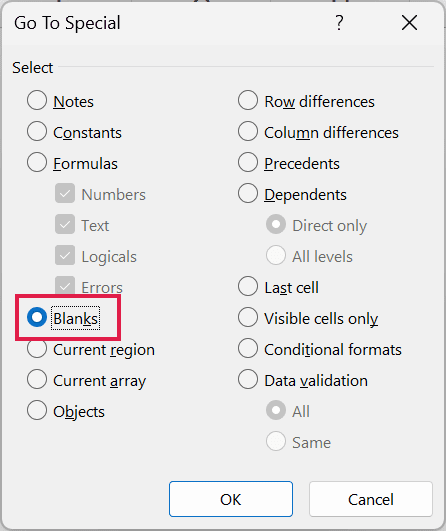
- Click OK
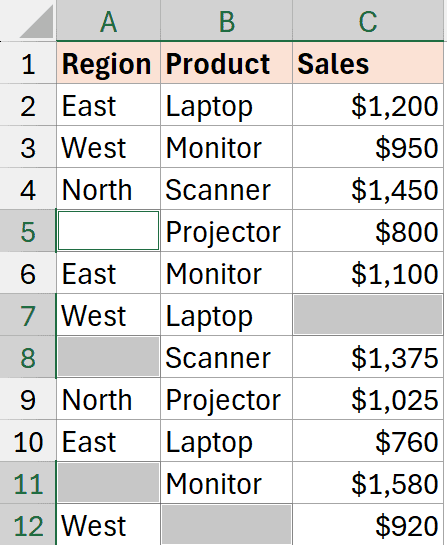
Excel selects every blank cell inside the range you started with. From there, you can fill them with a value, delete the rows, color them, or do anything else.
Pro Tip: If you skip step 1 and don’t select a range first, Excel checks the entire used area of the sheet. That’s fine for small sheets, but it can be slow on large workbooks.
A couple of things to know.
- Go To Special only catches cells that are truly empty. If a cell holds a formula that returns an empty string (like
=IF(A1=1,"Yes","")), Excel does not treat it as blank, and the method skips it. - Hidden rows and filtered-out rows inside the selection are still included, so if you need to skip those, select only visible cells first.
Find and Select Blank Cells Using Find & Replace
Most people only think of Find & Replace as a tool for finding text.
But it can also find empty cells, and it does it in a way that gives you a list of every blank cell address before you select them.
That makes it useful when you want to eyeball the blanks before you act on them.
Here are the steps to find and select blank cells using Find & Replace:
- Select the range you want to search
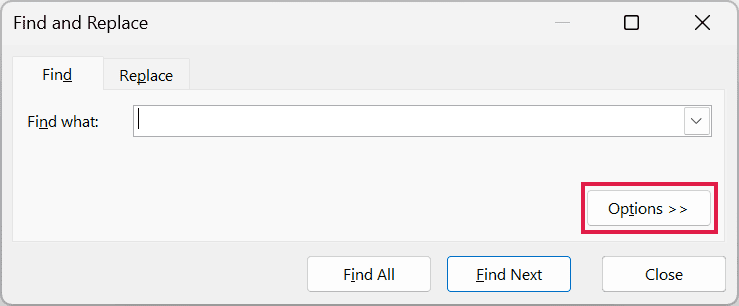
- Press Ctrl + F to open the Find and Replace dialog
- Leave the Find what box empty
- Click Options to expand the dialog
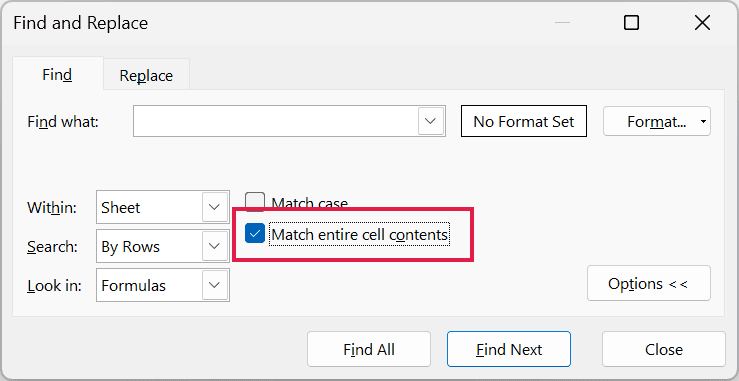
- Check the Match entire cell contents box
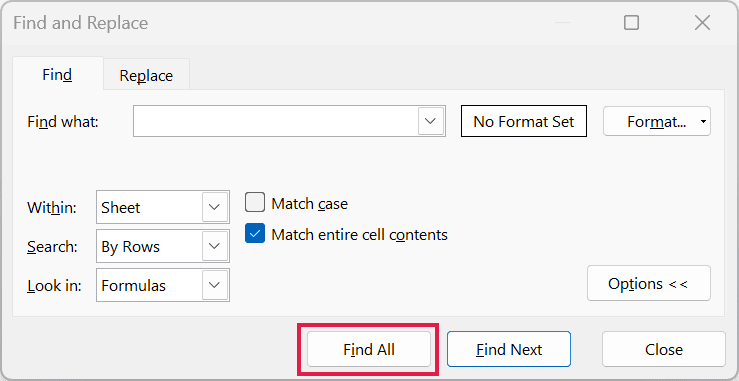
- Click Find All
- With the results list visible, press Ctrl + A to select every result
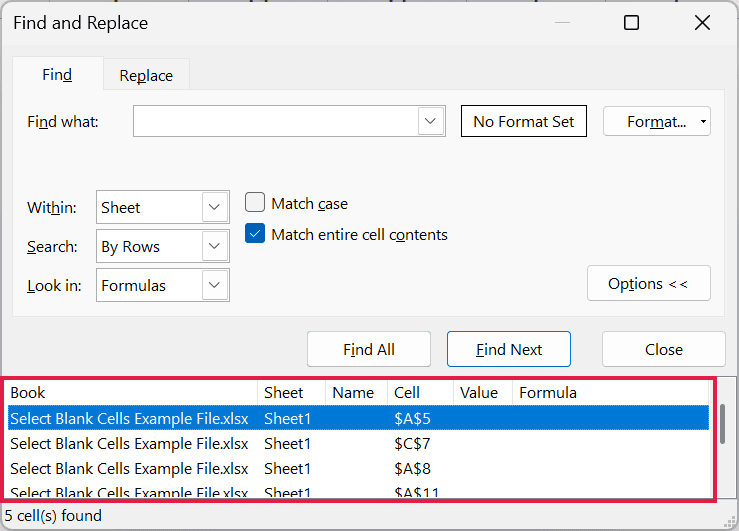
- Click Close
All the blank cells in the range are now selected, and you can act on them.
The Match entire cell contents checkbox is the important part. Without it, Excel matches the empty string inside every cell (which is everywhere) instead of cells that are completely empty.
Unlike Go To Special, this method also gives you a clickable list of every blank cell address. That’s handy when you want to inspect the blanks before doing anything to them.
Find & Replace is also a useful trick when you need to select non-adjacent cells that share a value.
Select Blank Cells Using a Filter
The Filter approach is for a different situation.
If you only care about blanks in one column (say, the Region column needs every blank row checked), filtering is faster than selecting all blanks across the whole sheet.
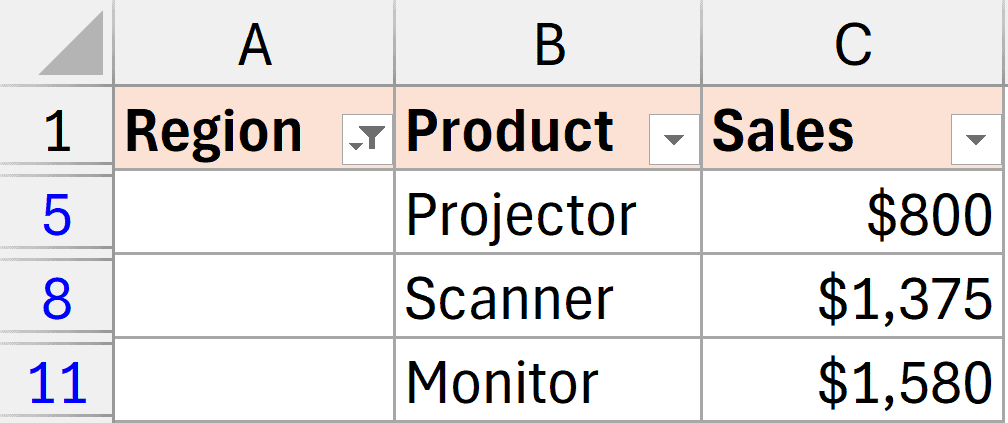
Same dataset as before. This time, I want to see only the rows where the Region is missing.
Here are the steps to filter for blank cells in a column:
- Click anywhere inside your dataset
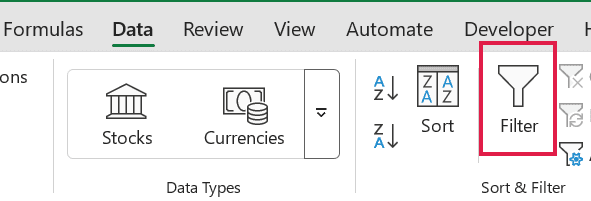
- Go to the Data tab and click Filter (or use the keyboard shortcut Ctrl + Shift + L)
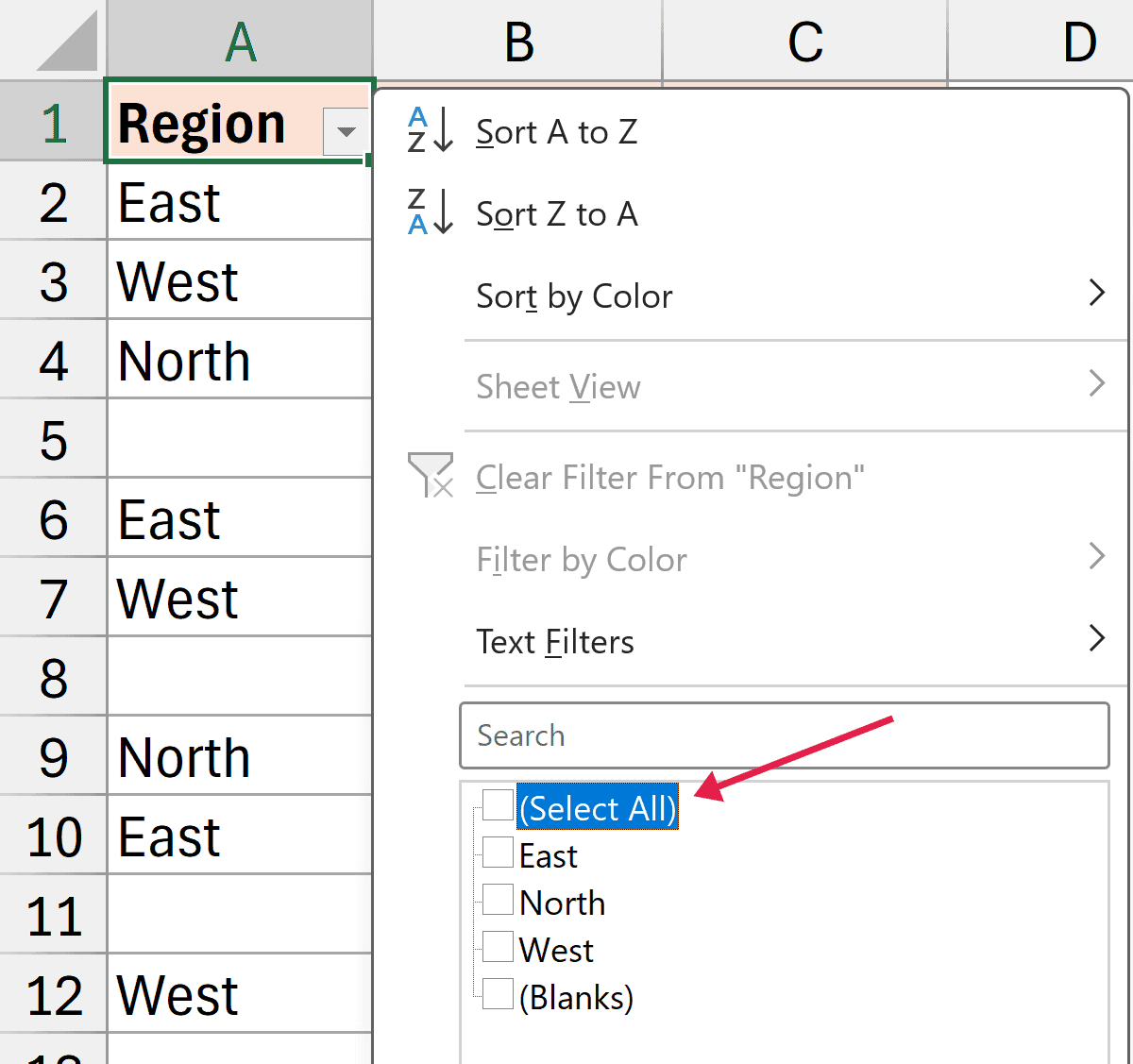
- Click the dropdown arrow at the top of the column you want to check
- Uncheck (Select All)
- Scroll to the bottom and check (Blanks)
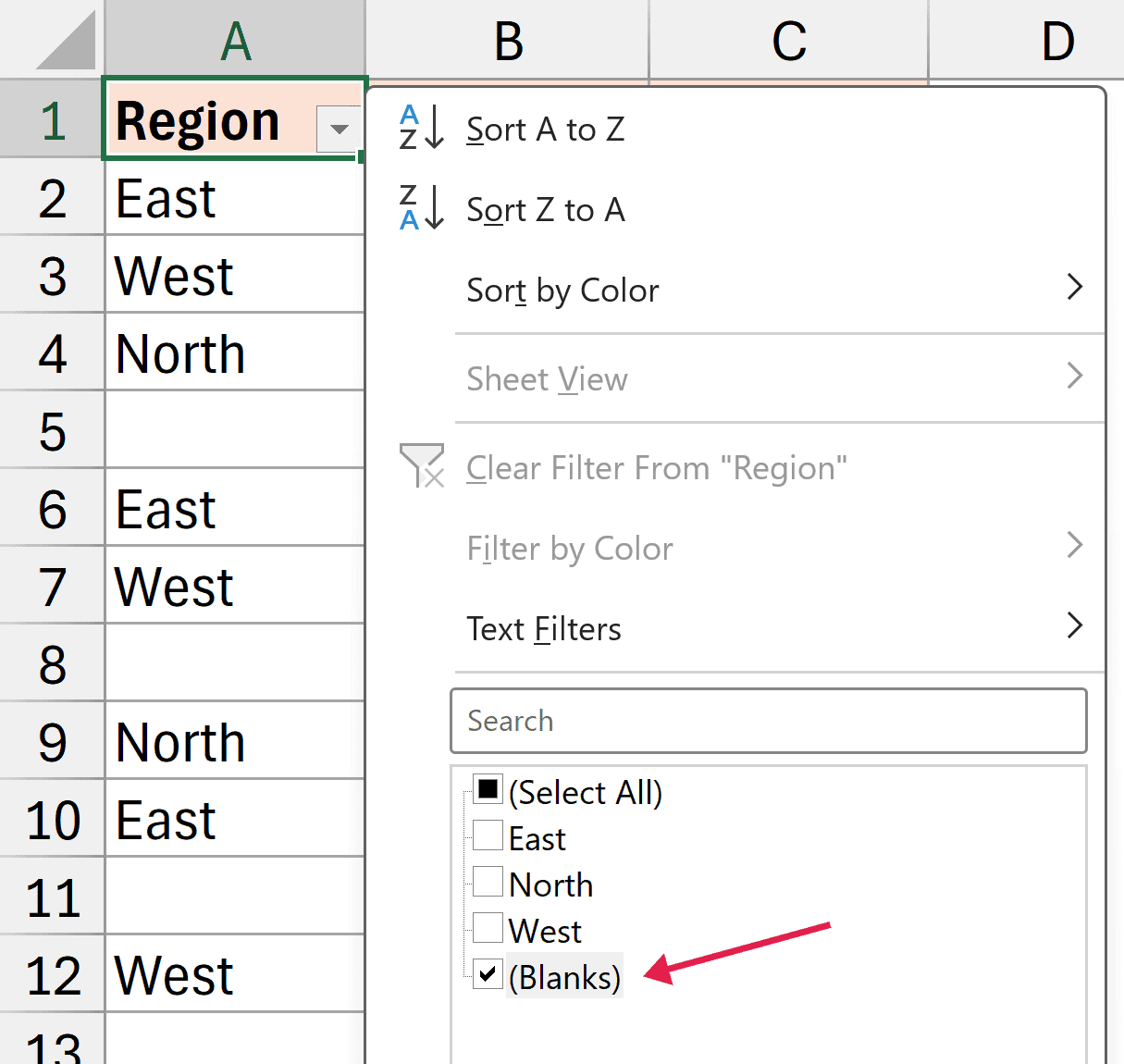
- Click OK
Now you only see rows where that column is empty. From there, you can select the visible cells, delete the rows, or fix the values directly.
A couple of things to keep in mind:
- The (Blanks) option only appears if the column actually has at least one blank cell.
- And this method filters whole rows where one column is blank. It does not select individual blank cells across the rest of the dataset. For that, use Go To Special.
Select Blank Cells Using VBA
If you find yourself selecting blank cells often, a one-line macro saves a few extra clicks each time. This is overkill for occasional use, but handy for a repeat workflow.
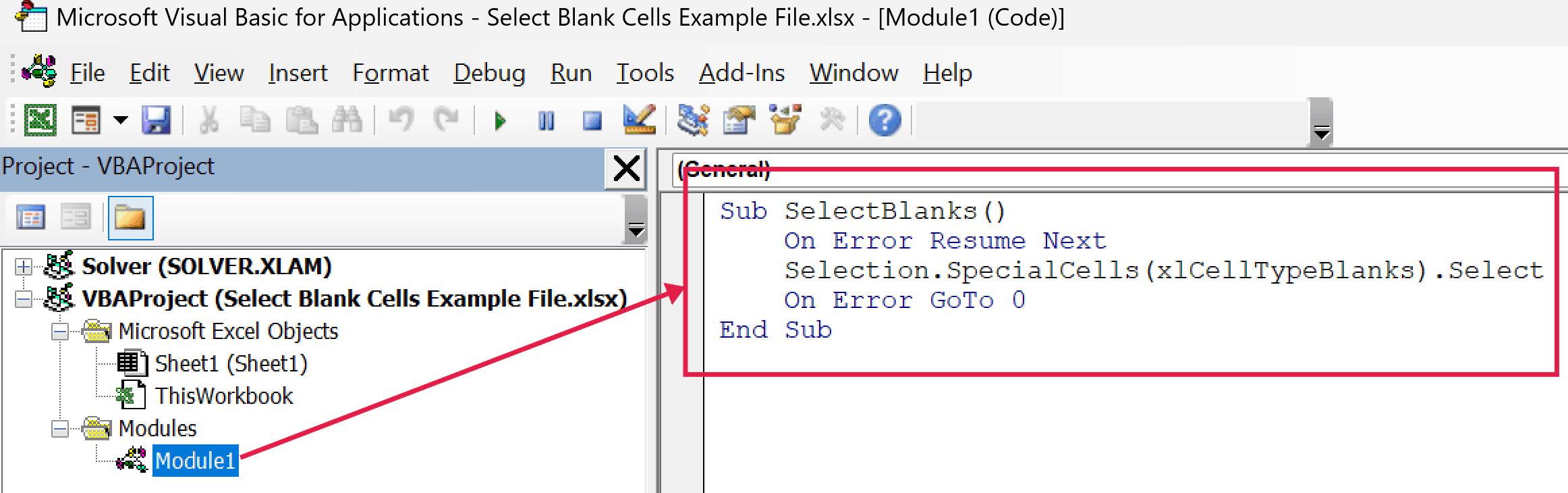
Here is the VBA code:
Sub SelectBlanks()
    On Error Resume Next
    Selection.SpecialCells(xlCellTypeBlanks).Select
    On Error GoTo 0
End SubHere are the steps to use this macro:
- Select the range containing the blank cells
- Press Alt + F11 to open the VBA editor
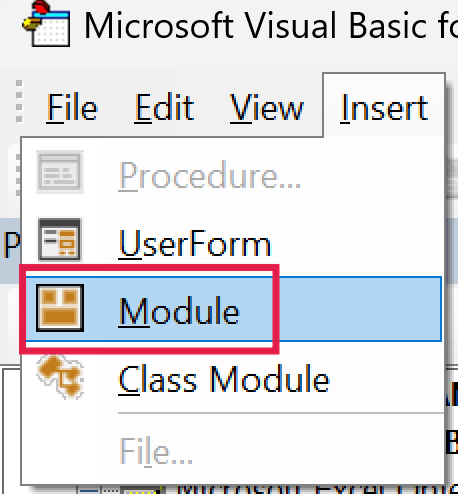
- Insert a new module (Insert → Module)
- Paste the code above
- Press F5 to run it, or close the editor and run it from the Developer tab
The macro selects every blank cell inside whatever range was active before you ran it.
The On Error Resume Next line is there so the macro doesn’t throw an error if the selection has no blank cells.
You can also assign this macro to a keyboard shortcut or a Quick Access Toolbar button, so it runs in one click every time.
Things to Keep in Mind
Two gotchas are worth flagging because they trip people up.
First, a cell with a formula returning an empty string ("") is not technically blank to Excel. The methods above skip those. If you want them included, replace the formulas with their values first (Copy, then Paste Special as Values).
Second, hidden and filtered-out rows are still part of any selection unless you specifically work with visible cells. So if you delete after a Go To Special, you might wipe out blanks you didn’t see.
One related thing: if your goal is to spot the gaps visually rather than act on them, you can also highlight blank cells in Excel using conditional formatting.
Honestly, 90% of the time I just use Go To Special. The shortcut is in my muscle memory, and it works on any range.
The other methods earn their place in specific situations: Find & Replace when I want to inspect the list first, Filter when I only care about one column, and VBA when I’m doing this in the same workbook over and over.
If selecting blanks is part of a broader cleanup, my guide on cleaning data in Excel covers a few more techniques worth knowing.
You May Also Like the Following Excel Tutorials:
- How to Deselect Cells in Excel
- How to Move Rows and Columns in Excel.
- How to Select Every Third Row in Excel (or select every Nth Row).
- How to Select 500 cells/rows in Excel (with a single click)
- Fill Down Blank Cells Until the Next Value in Excel (Formula, VBA, Power Query)
- How to Select Entire Column in Excel
- Select Every Other Row in Excel
- Count Cells That Are Not Blank in Excel

Thanks Sumit. Great tips hey, learning a lot.